Given the robust nature of learning sciences research, this website is best viewed on tablets and computers. A small screen experience is coming in the future.
On June 22, 2021, we will launch updated strategies for the Math PK-2 model, as well as additional updates to the Navigator that highlight equity, SEL, and culturally responsive teaching. To learn more, visit our Site Updates (available in the "About" menu at the top of any page).

Hover to see how factors connect to Home Learning Environment. Then click connected factors to explore strategies related to multiple factors.
A student's Home Learning Environment (HLE) is the environment families and caregivers provide that supports students in growing their core mindsets around thinking and learning. The Home Learning Environment includes the availability of educational materials in the home, as well as family engagement and values around learning (related to Social Supports). A student's Home Learning Environment can promote future academic success and socio-emotional well-being, provide opportunities for students to learn about their Identities, and provide connections to a student's culture and community. By learning more about students' Home Learning Environments, educators can better understand and build learning around the rich funds of knowledge and skills students bring with them.
The Home Learning Environment plays a large role in how young learners engage with many aspects of their Identity (for example, their culture), typically use their Primary Language, and learn important socioemotional skills (like an ability to effectively communicate, or understand others' Emotions). In addition, the Home Learning Environment provides children with the academic skills and attitudes critical for school success. In the US, schooling systems do not always take full advantage of the rich Background Knowledge students come into school with, especially students from historically and systematically excluded backgrounds. Educators, however, can provide a classroom environment where students' cultural knowledge and traditions are valued, validating and respecting different ways of knowing.
The Home Learning Environment has at least three main components:
Each component of the Home Learning Environment promotes learning and development in related but slightly different ways. Because educational materials help children practice and learn key skills, the availability of these materials in the Home Learning Environment predicts later academic success. For example, books in the home promote early literacy; puzzles and counting games promote early math development; and blocks or drawing materials promote early fine motor development.
Caregiver engagement is also a critical aspect of the Home Learning Environment: children tend to learn better when a caregiver is available and able to guide and help them along. Caregivers can teach their children new things, scaffold their learning, and help practice existing skills. For example, caregivers help children learn about their culture, typically teach children their Primary Language (or languages), teach children how to manage their Emotions and resolve conflicts, and prepare children to engage in the world via socialization (the process through which children learn about their own racial and ethnic background, as well as others'. Similarly, when using technology, joint media engagement, or co-viewing practices between caregivers and children can help model and encourage healthy digital behavior for young children and potentially mitigate some of the negative effects often associated with media use in young children. Finally, caregivers' values matter, because they guide the kinds of learning opportunities they provide and the kinds of achievements they prize and encourage. For example, families in the U.S. typically value academic success, but some may place a higher value on early academic skills. Caregivers can also vary in the extent to which they value traits like independence or collectivism vs. individualism.
Family involvement at school is related to the Home Learning Environment, because caregivers who understand what skills their children need to work on, and know how to scaffold those skills, can help create a more effective Home Learning Environment. However, not all families are equally able to engage. Intergenerational trauma (e.g., the cultural erasure and abuse of Native peoples in residential schools) or negative school experiences (e.g., being dismissed or treated poorly by school personnel) can get in the way of family school engagement. Educators can help by creating a warm and welcoming environment not just for students, but for their families: trying to form connections with students' families, understand their goals and values, and learn more about the funds of knowledge students bring to school.
Importantly, children's homes and caregiver structures can look different. For example, in many cultures it is common for children to live in multigenerational families, where they have access to many more caregivers. On the other hand, many families in the U.S. face housing insecurity. To best support students and their families, it is important for educators to understand their students' Home Learning Environment, and remain aware that this environment can change. Knowing the strengths, challenges, and learning needs of the caregivers at home can also give important insight for educators in providing support for students with learning disabilities and ADHD, both of which can run in families.
Project-based learning (PBL) actively engages learners in authentic tasks designed to create products or design solutions that answer a given question or solve a problem.
Encouraging children to draw and to explain their drawings in the classroom, can support the development of Core Academic Literacies, especially when solving complex problems across content areas.
Visiting places connected to classroom learning provides opportunities to add relevance to classroom topics and deepen understanding through firsthand experiences.
Games support learning, as learners engage with new information in fun and informal ways.
Gallery walks are ways of showcasing content and materials as multiple “exhibitions” for students to view and interact with as part of larger learning goals.
Think-Pair-Share (TPS), also known as Turn & Talk (T&T), is when the teacher pauses instruction so students can discuss a topic or prompt in pairs or small groups, to enhance engagement and learning outcomes.
Read-alouds are an instructional practice in which teachers read aloud from a text to students, modeling fluent reading, asking questions, and actively engaging with students to enhance their understanding.
In guided inquiry, teachers scaffold student learning and help students use their own language to construct knowledge by active listening and questioning.
Supported independent reading, sometimes called Scaffolded Silent Reading, is when teachers scaffold and monitor learners' independent reading time, offering students a choice of accessible texts, and periodic check-in's with individual students to provide guidance and accountability.
Multimodal teaching and learning provide opportunities for students to engage with the same content through different sensory modalities, such as visual, auditory, and tactile.
A strengths-based approach is one where educators intentionally identify, communicate, and harness students' assets, across many aspects of the whole child, in order to empower them to flourish.
Audiobooks, digital text-to-speech books, and e-books are digital formats of literature that allow for portable and accessible reading experiences through audible narration and/or a written electronic version of a text.
Communication boards are displays of graphics (e.g., pictures, symbols, illustrations) and/or words where learners can gesture or point to the displays to extend their expressive language potential.
Music and dance support learners in a myriad of ways, including supporting their engagement and motivation, connecting with cultural backgrounds, and offering structure during play.
Providing students a voice in their learning is critical for making learning meaningful.
Culturally responsive texts include those that reflect different facets of students' identities, including race, ethnicity, gender, socioeconomic, and disability status, as well as the intersections of those identities.
Discussing race with students can range from conversations on cultural celebration (e.g., celebrating the importance of diversity) to developing critical consciousness (e.g., understanding the impact of social inequities like racism and how to dismantle it).
Family engagement happens when educators and schools collaborate with families to collectively support their child's learning in meaningful ways, both at school and at home.
Translanguaging is a flexible classroom practice enabling students to listen, speak, read, and write across their multiple languages or dialects, even if the teacher does not have formal knowledge of these additional languages.
Spaced practice is a learning strategy that deliberately spaces out learning or study sessions over varying periods of time, with the purpose of increasing retention, understanding, and long-term knowledge acquisition.
Retrieval practice requires students to access information, or get information “out” from Long-term memory in order to support better retention and understanding.
When classrooms are intentionally designed to promote inclusion, belonging, and accessibility, they positively influence key learner factors, including Attention, Self-Regulation, Learner Mindset, and Sense of Belonging.
 Except where otherwise noted, content on this site is licensed under a Creative Commons Attribution-NonCommercial 4.0 International License
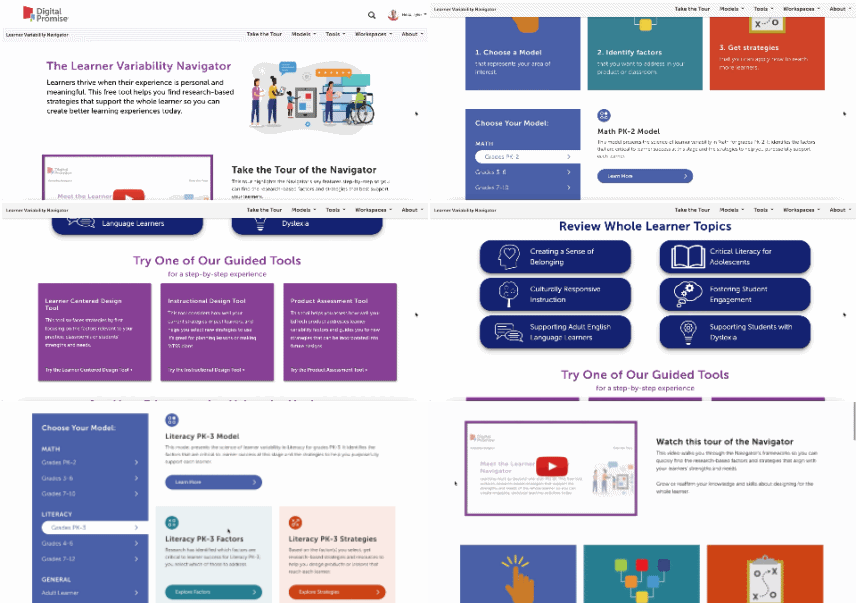
This is our homepage. You can access many of the features of the Navigator here, and learn more about how learner variability intersects with topics in education and learning. To start, select a content area – we call them Learner Models – to visit a factor map.
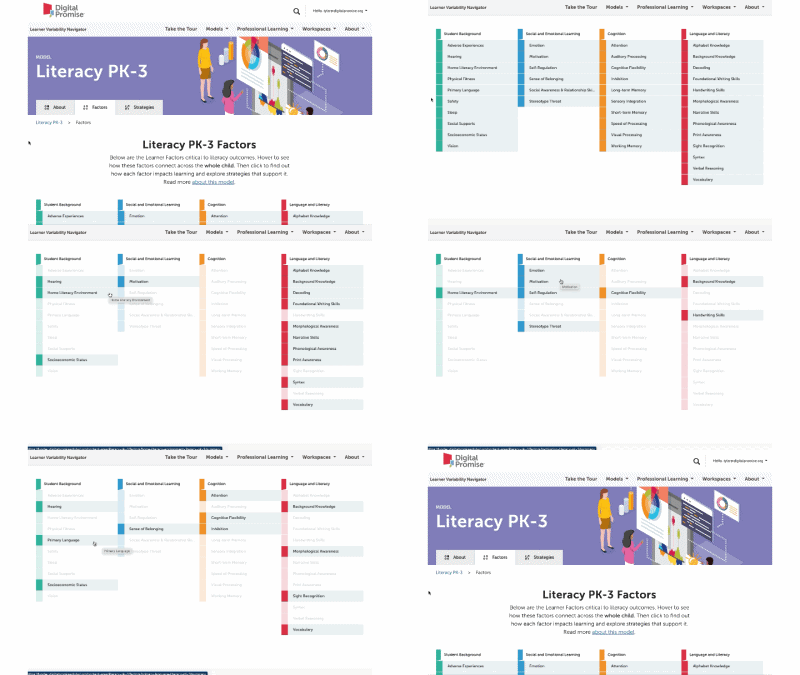
Factor maps show research-based concepts, "factors," that likely impact learning. They are organized into four categories: Learner Background, Social and Emotional Learning, Cognition, and Content Area. The map is interactive. Move your cursor over a factor to see connected factors. Select any factor to visit its summary page. We'll look at factor summary pages next.
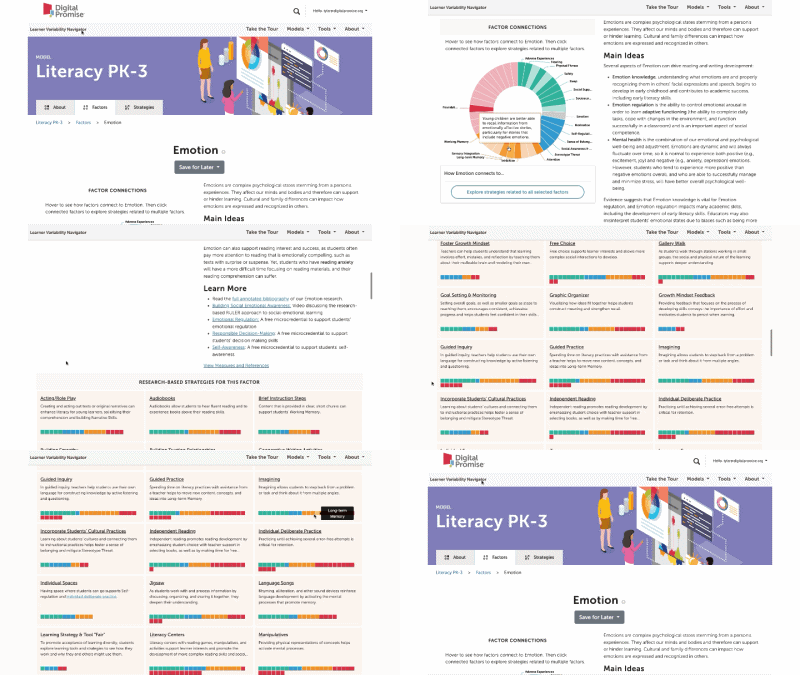
This is a factor summary page. It provides a brief definition and review of the factor, a factor connections diagram, additional resources, and strategies that support this factor. On the strategy card, the multi-colored boxes show all the factors that it supports. Select a strategy to visit its summary page.
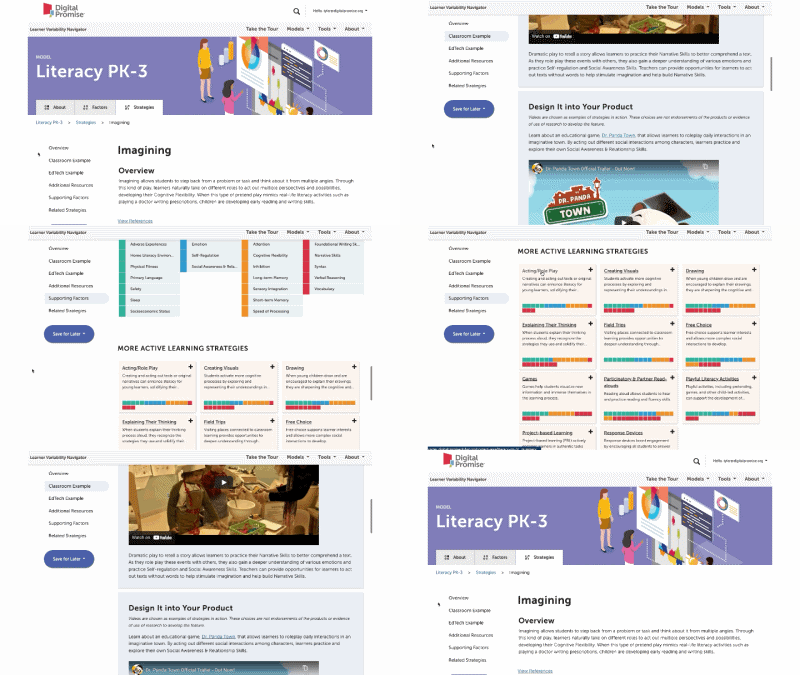
Strategy summary pages have an overview, information about using the strategy in different learning environments, resources of interest, the factors this strategy supports, and related strategies you can explore. To view all the strategies in a content area, use the strategies tab at the top of the page. We'll look at all the Strategies for this learner model next.
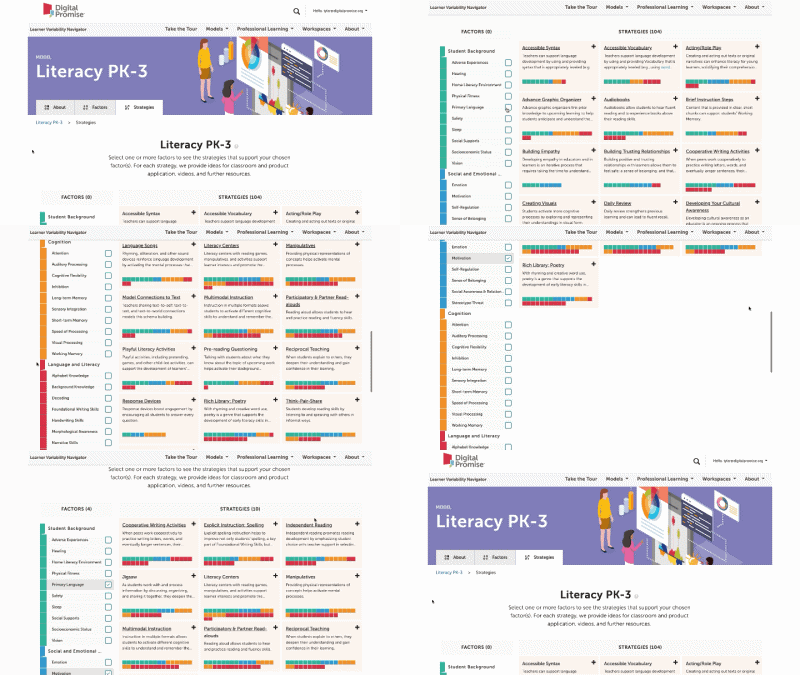
The strategy page shows ALL of the strategies for that learner model. You can select factors of interest for you or your learners, and it will narrow the strategies to only those that match all of the factors selected. This makes it easy to find key strategies to better design for learner variability. Again, select the strategy name to visit its summary page.


Already a user? LOG IN
Are you sure you want to delete this Workspace?
Enter the email address of the person you want to share with. This person will be granted access to this workspace and will be able to view and edit it.
Adjust the permissions of your Workspace.
This Workspace is .
This Workspace's Reflection Area is .
Learner variability is the recognition that each learner is a unique constellation of strengths and challenges that are interconnected across the whole child. Understanding these connections and how they vary according to context is essential for meeting the needs of each learner.
It disrupts the notion of a one-size-fits all education. Understanding learner variability helps educators embrace both students’ struggles and strengths as we connect practice to uplifting the whole learner.
Throughout the site, we talk about "factors" and "strategies." Factors are concepts research suggests have an impact on how people learn. Strategies are the approaches to teaching and learning that can be used to support people in how they learn best.
Use the Learner Centered Design Tool to build a workspace. Go to Learner Centered Design Tool.
Or, create a new blank workspace for your product or project.
Use one of the guided tools to build a workspace.
Or, create a new blank workspace for your product or project.
Make a copy of this workspace.
Redirecting soon...
Generating summary page
Loading...
On this page, using your heatmap, you will be asked to select factors to further explore, and then select new strategies you might incorporate into upcoming instruction. Once done, click “Show Summary" to view your Design Summary Report.
On this page, using your heatmap, you will be asked to select factors to further explore, and then select new strategies you might incorporate into upcoming instruction. Once done, click “Show Report” to view your Design Summary Report.
By selecting "Show Report" you will be taken to the Assessment Summary Page. Once created, you will not be able to edit your report. If you select cancel below, you can continue to edit your factor and strategy selections.
Announcement here
Item successfully added to workspace!
Issue adding item to workspace. Please refresh the page and try again.
Learner variability is the recognition that each learner is a unique constellation of strengths and challenges that are interconnected across the whole child. Understanding these connections and how they vary according to context is essential for meeting the needs of each learner. It embraces both students’ struggles and strengths. It considers the whole child.
Throughout the site, we talk about "factors" and "strategies." Factors are concepts research suggests have an impact on how people learn. Strategies are the approaches to teaching and learning that can be used to support people in how they learn best.
The Learner Variability Navigator is a free, online tool that translates the science of learner variability into factor maps and strategies that highlight connections across the whole learner. This puts the science of learning at teachers' fingertips, empowering them to understand their own practice and support each learner.
