Given the robust nature of learning sciences research, this website is best viewed on tablets and computers. A small screen experience is coming in the future.
On June 22, 2021, we will launch updated strategies for the Math PK-2 model, as well as additional updates to the Navigator that highlight equity, SEL, and culturally responsive teaching. To learn more, visit our Site Updates (available in the "About" menu at the top of any page).

Hover to see how factors connect to Stereotype Threat. Then click connected factors to explore strategies related to multiple factors.
Within our society, a variety of stereotypes exist about the academic abilities of learners based on facets of their Identity (e.g., race, gender, disability), or backgrounds (e.g., Socioeconomic Status, Primary Language). Stereotypes can be harmful to a host of outcomes for learners, and threaten learners' social interactions and functioning within school settings. Stereotype Threat occurs when a negative bias or stereotype that exists in a culture about a group results in suboptimal academic performance by people who identify with that group. Specifically, learners who are aware of this stereotype can fear confirming it—especially when the relevant aspect of their Identity is made salient. This can result in reduced academic performance that is not indicative of a learner's actual capabilities. Engaging in discussions around these stereotypes and their baselessness can support adolescents' resistance to the negative effects of Stereotype Threat.
By the end of preschool, children have typically already been exposed to and become aware of stereotypes about different groups, including those they identify with. For example, 6-year-old girls already believe boys are better at robotics and computer science. Such effects of negative stereotypes can lead to a decreased Sense of Belonging and Motivation in these domains—and these effects can have long term and lasting consequences. Experiencing Stereotype Threat can lead adolescents to disengage with a domain and reframe it as less important down the line, called disidentification. This may be one way that Stereotype Threat can affect learners earlier in life as well, interfering with their ability and Motivation to persist in these domains, leading to reduced Core Academic Literacies. Together, these harmful effects of stereotypes contribute to academic disparities between groups, and may explain why girls as well as Black, Latinx and Indigenous students are underrepresented in STEM fields.
Learners can experience Stereotype Threat across a variety of contexts, and this is especially likely when an aspect of their Identity that is associated with negative stereotypes is made salient (by prompting a learner to consider this aspect of their Identity), and when they believe they are being evaluated on a task relevant to this negative stereotype. Stereotype Threat can lead to negative learning outcomes because learners who fear confirming a negative stereotype about a group they identify with tend to experience negative thoughts and Emotions. This reduces their Working Memory capacity, thus disrupting academic performance. For example, boys are often stereotyped as less capable readers than girls, with Black and Latinx learners also at risk of this stereotype. Girls are at risk of Stereotype Threat in STEM domains. And, students with ADHD and learning disabilities are at risk of Stereotype Threat across social and academic domains due to anxiety and low self-esteem from stigma and internalized ableism.
It is also important to note that Identity is intersectional and fluid: as we interact with our environment, we may call to mind some aspects of our identity more than others. For example, although Asian-American girls often experience Stereotype Threat in the math domain when their gender identity is made salient, these learners can actually show a boost in performance, called Stereotype Lift. However, “positive” or “model minority” stereotypes are more often harmful than they are helpful—for example, by college, learners who face such stereotypes can feel pressured to perform, resulting in anxiety and reduced (rather than improved) academic performance.
Stereotype Threat is most likely to affect learners who are aware of negative stereotypes about a group they identify with, and who most highly value achievement in the relevant domain, called domain identification. Stereotype Threat may also be more likely to affect learners who regard an aspect of their identity as more “central” or important. Importantly, even individuals who do not believe the stereotype is true about their group can often experience the negative effects of Stereotype Threat, and learners can still experience Stereotype Threat even if they do not personally experience prejudiced behavior toward them by teachers or peers.
Research suggests that, like everyone else, teachers may hold stereotypes about their students, either consciously or unconsciously. These stereotypes negatively affect students down the line (including via Stereotype Threat). It is important for educators to reflect upon their own biases, and consider whether these biases may be influencing students. There are two types of stereotypes people (including educators) can hold about others:
In addition, people who have encountered these stereotypes may hold self-stereotypes, or self-stigmas, which are internalized beliefs about their abilities that are formed from exposure to stereotypes that they have encountered around their Identities and can impede self-esteem and Sense of Belonging. It is important that educators consider how these self-stereotypes may be affecting not only their students, but also their own beliefs. Based on how Stereotype Threat often occurs, there are a couple other ways the effects of Stereotype Threat can be reduced in the classroom. First, Stereotype Threat typically occurs when learners believe they are being tested, and that the test is diagnostic of their abilities. Presenting assessments as “activities”, “games”, or “challenges”, may reduce the effects of Stereotype Threat in the classroom. Second, Stereotype Threat often occurs when a learner's negatively-stereotyped identity is activated before or during an assessment, for instance, when filling in demographic information at the start of an exam. Planning activities and assessments with this in mind, along with other considerations, can help reduce the potential for Stereotype Threat. In addition, encouraging learners to view intelligence as malleable rather than fixed (a growth Learner Mindset) can help learners overcome the effects of Stereotype Threat. However, it is important for educators to strive to prevent Stereotype Threat from occurring rather than placing the additional burden of coping onto students who experience it.
Project-based learning (PBL) actively engages learners in authentic tasks designed to create products or design solutions that answer a given question or solve a problem.
Flexible grouping is a classroom practice that temporarily places students together in given groups to work together, with the purpose of achieving a given learning goal or activity.
When students are able to encourage themselves through kind and motivating self-statements, they are practicing positive self-talk.
Growth mindset is the belief that people can grow their intelligence and abilities (through effort, good strategies, and support from others).
Culturally responsive texts include those that reflect different facets of students' identities, including race, ethnicity, gender, socioeconomic, and disability status, as well as the intersections of those identities.
Developing cultural awareness as an educator is an ongoing process that includes a recognition and appreciation for the full diversity of students and an understanding of how one's own Identity intersects with students' Identities.
Equitable grading systems and practices reimagine how to communicate student progress and mastery through various methods that reduce subjectivity and increase opportunities to learn.
Discussing race with students can range from conversations on cultural celebration (e.g., celebrating the importance of diversity) to developing critical consciousness (e.g., understanding the impact of social inequities like racism and how to dismantle it).
Learning about students' cultures and connecting them to instructional practices helps foster a Sense of Belonging, increase positive student Identity development, and mitigate Stereotype Threat.
Family engagement happens when educators and schools collaborate with families to collectively support their child's learning in meaningful ways, both at school and at home.
A first step to supporting learners is truly understanding who they are.
Checking in with learners, or taking the time to talk with individual learners about their experiences or goals, is important for fostering a positive classroom environment.
Shadowing a student involves an educator, administrator, or designated adult observing a learner across different parts of their day to deepen their understanding of that learner's experience beyond their classroom.
Developing empathy in educators and in learners is an iterative process that requires taking the time to understand and honor others' perspectives.
A rubric is a tool that communicates expectations for success for students to achieve and can include symbols or charts that are easy for students to understand.
Feedback is the process of providing learners with information about their learning to support their progress and improvement, and can come from a range of sources, including teachers and peers.
Youth participatory action research (YPAR) is a student-centered approach that puts the learner at the helm of the research process, from ideation to dissemination, to investigate and advocate for change they want to see in their schools and communities.
An open classroom climate is an educational environment where students feel comfortable and confident expressing their opinions in class.
Spaced practice is a learning strategy that deliberately spaces out learning or study sessions over varying periods of time, with the purpose of increasing retention, understanding, and long-term knowledge acquisition.
Retrieval practice requires students to access information, or get information “out” from Long-term memory in order to support better retention and understanding.
Building positive and trusting relationships with learners fosters a Sense of Belonging, safety, and engagement, laying the groundwork for academic, cognitive, and social-emotional growth.
Pre-assessments are tools or activities used before instruction begins to help educators understand what students already know, understand, or can do—and where they may need support.
 Except where otherwise noted, content on this site is licensed under a Creative Commons Attribution-NonCommercial 4.0 International License
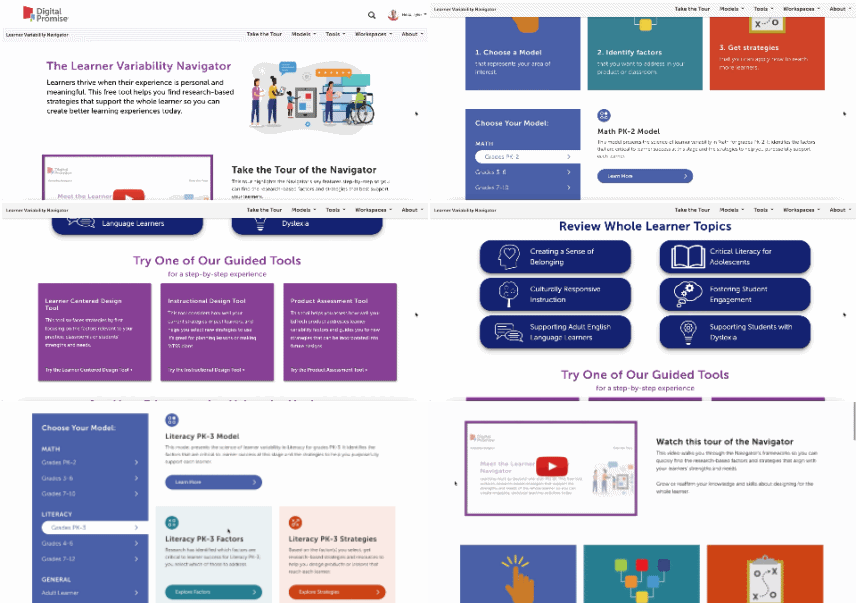
This is our homepage. You can access many of the features of the Navigator here, and learn more about how learner variability intersects with topics in education and learning. To start, select a content area – we call them Learner Models – to visit a factor map.
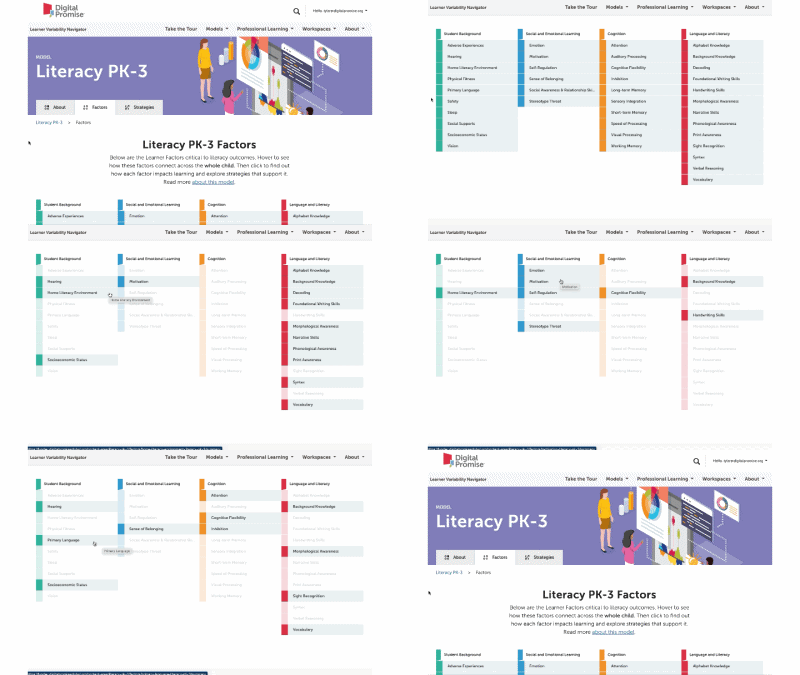
Factor maps show research-based concepts, "factors," that likely impact learning. They are organized into four categories: Learner Background, Social and Emotional Learning, Cognition, and Content Area. The map is interactive. Move your cursor over a factor to see connected factors. Select any factor to visit its summary page. We'll look at factor summary pages next.
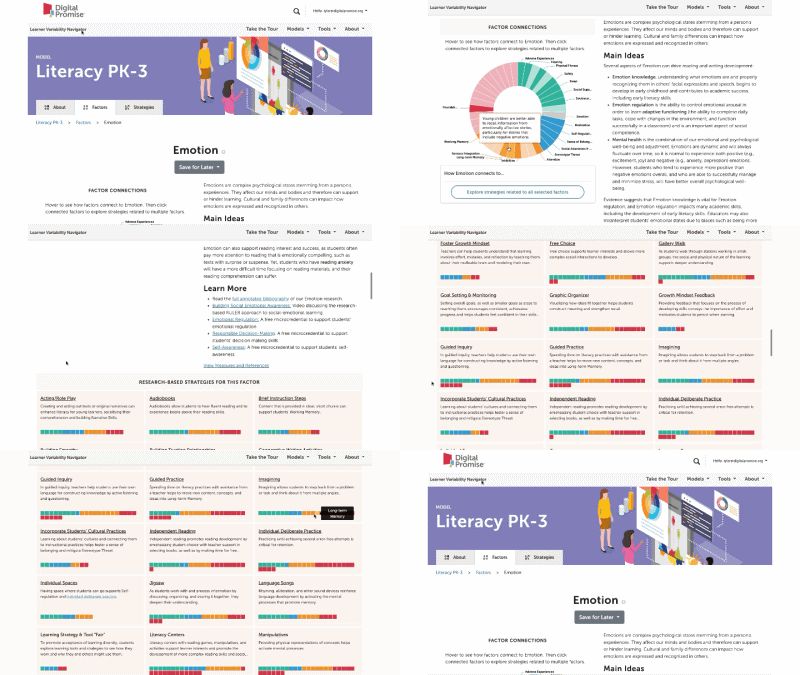
This is a factor summary page. It provides a brief definition and review of the factor, a factor connections diagram, additional resources, and strategies that support this factor. On the strategy card, the multi-colored boxes show all the factors that it supports. Select a strategy to visit its summary page.
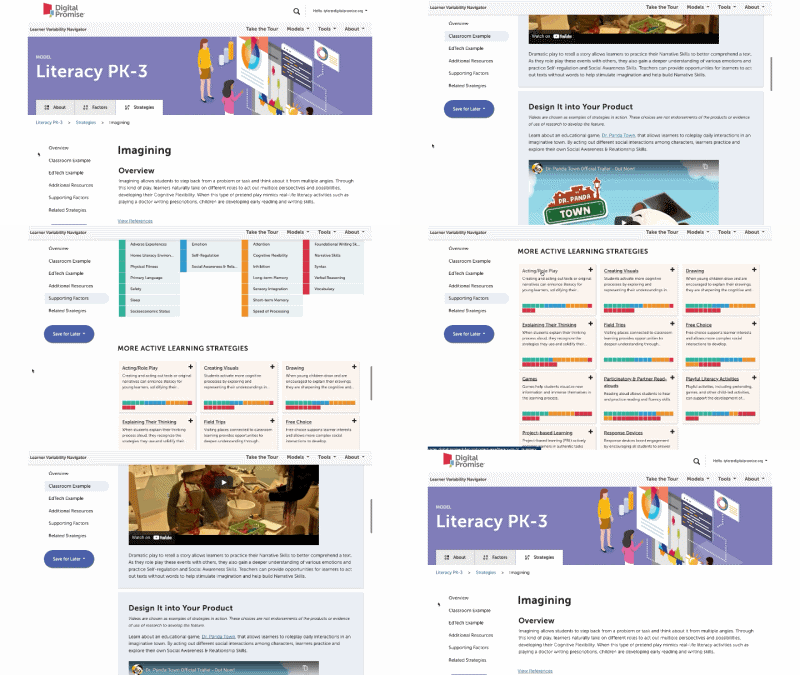
Strategy summary pages have an overview, information about using the strategy in different learning environments, resources of interest, the factors this strategy supports, and related strategies you can explore. To view all the strategies in a content area, use the strategies tab at the top of the page. We'll look at all the Strategies for this learner model next.
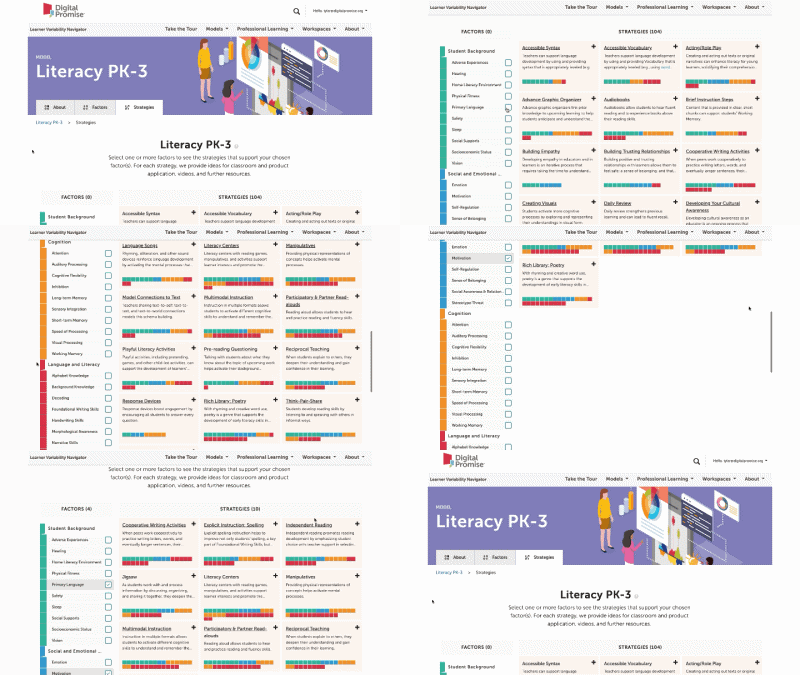
The strategy page shows ALL of the strategies for that learner model. You can select factors of interest for you or your learners, and it will narrow the strategies to only those that match all of the factors selected. This makes it easy to find key strategies to better design for learner variability. Again, select the strategy name to visit its summary page.


Already a user? LOG IN
Are you sure you want to delete this Workspace?
Enter the email address of the person you want to share with. This person will be granted access to this workspace and will be able to view and edit it.
Adjust the permissions of your Workspace.
This Workspace is .
This Workspace's Reflection Area is .
Learner variability is the recognition that each learner is a unique constellation of strengths and challenges that are interconnected across the whole child. Understanding these connections and how they vary according to context is essential for meeting the needs of each learner.
It disrupts the notion of a one-size-fits all education. Understanding learner variability helps educators embrace both students’ struggles and strengths as we connect practice to uplifting the whole learner.
Throughout the site, we talk about "factors" and "strategies." Factors are concepts research suggests have an impact on how people learn. Strategies are the approaches to teaching and learning that can be used to support people in how they learn best.
Use the Learner Centered Design Tool to build a workspace. Go to Learner Centered Design Tool.
Or, create a new blank workspace for your product or project.
Use one of the guided tools to build a workspace.
Or, create a new blank workspace for your product or project.
Make a copy of this workspace.
Redirecting soon...
Generating summary page
Loading...
On this page, using your heatmap, you will be asked to select factors to further explore, and then select new strategies you might incorporate into upcoming instruction. Once done, click “Show Summary" to view your Design Summary Report.
On this page, using your heatmap, you will be asked to select factors to further explore, and then select new strategies you might incorporate into upcoming instruction. Once done, click “Show Report” to view your Design Summary Report.
By selecting "Show Report" you will be taken to the Assessment Summary Page. Once created, you will not be able to edit your report. If you select cancel below, you can continue to edit your factor and strategy selections.
Announcement here
Item successfully added to workspace!
Issue adding item to workspace. Please refresh the page and try again.
Learner variability is the recognition that each learner is a unique constellation of strengths and challenges that are interconnected across the whole child. Understanding these connections and how they vary according to context is essential for meeting the needs of each learner. It embraces both students’ struggles and strengths. It considers the whole child.
Throughout the site, we talk about "factors" and "strategies." Factors are concepts research suggests have an impact on how people learn. Strategies are the approaches to teaching and learning that can be used to support people in how they learn best.
The Learner Variability Navigator is a free, online tool that translates the science of learner variability into factor maps and strategies that highlight connections across the whole learner. This puts the science of learning at teachers' fingertips, empowering them to understand their own practice and support each learner.
