Building positive and trusting relationships with learners fosters a Sense of Belonging, safety, and engagement, laying the groundwork for academic, cognitive, and social-emotional growth.
Helping learners self-assess their behavior helps develop their Self-regulation, monitor their comprehension during reading, and think through strategies during math tasks.
Research does not support matching instruction to perceived “learning styles,” (which are not in fact supported by research) but rather, offering a range of modalities to benefit all learners.
Tasks can be designed to have learners solve real-world problems, sharpen Critical Thinking Skills, and build Communication skills as learners Collaborate.
National Academies of Sciences, Engineering, and Medicine. (2018). How people learn II: Learners, contexts, and cultures. National Academies Press. Retrieved from https://www.nap.edu/catalog/24783/how-people-learn-ii-learners-contexts-and-cultures
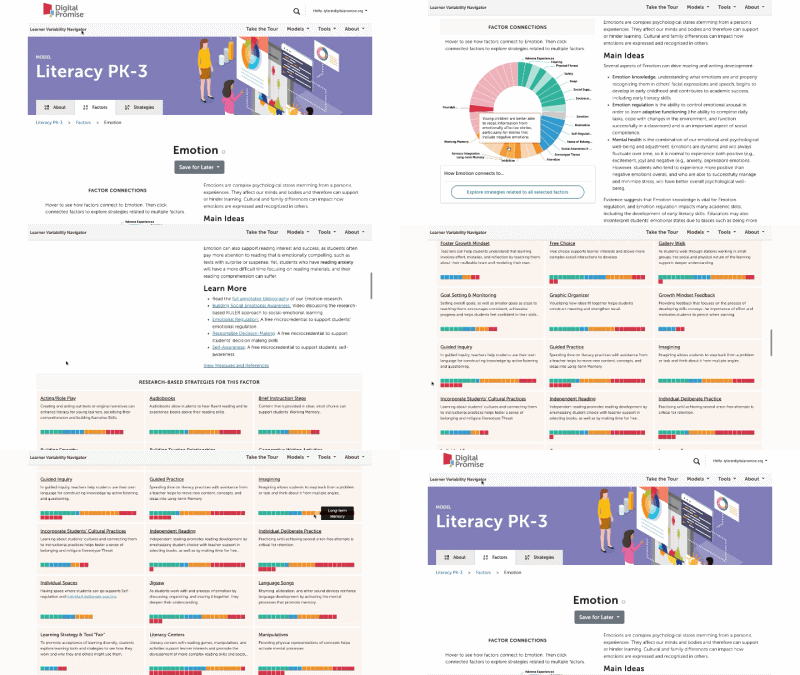
Students from diverse backgrounds and cultures, as well as students with learning disorders or ADHD, may have ways of expressing their Emotions, perceiving Emotions in others, and reacting to Emotions that differ from what we expect to see from young learners.
Tasks can be designed to have learners solve real-world problems, sharpen Critical Thinking Skills, and build Communication skills as learners Collaborate.
Learners who think critically ask thoughtful questions, and consider multiple forms of evidence when drawing an inference.
Mnemonic strategy instruction has been shown to be highly effective for students with learning disabilities who may have difficulties with Working Memory, likely by giving learners an opportunity to encode information in multiple ways.
Each adult learner will have a unique work and life approach leading to variation in the amount and depth of preferred check-ins.
 Except where otherwise noted, content on this site is licensed under a Creative Commons Attribution-NonCommercial 4.0 International License


Already a user? LOG IN