Alibali, M. W., & Nathan, M. J. (2012). Embodiment in mathematics teaching and learning: Evidence from learners' and teachers' gestures. Journal of the Learning Sciences, 21(2), 247-286.
Products can build on young learners' intuitive Non-symbolic Number knowledge by providing different arrangements of the same number of dots.
Diverse collections of poetry can also engage all learners in textual analysis and provide a channel for self-expression and creativity.
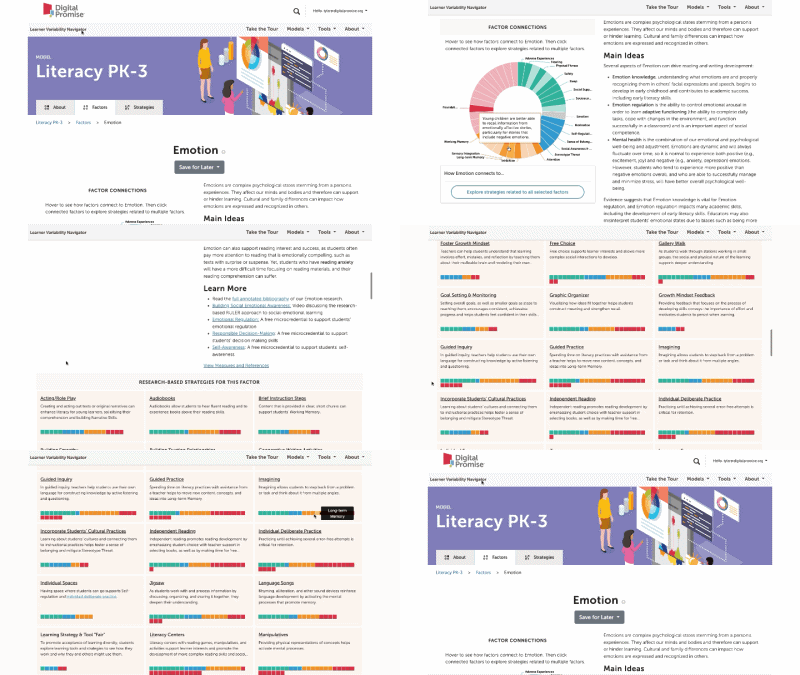
With verbal repetition, learners can personalize, interact with, and use their own words to explain the information, activating multiple brain pathways to show understanding and help move knowledge from Short- to Long-term Memory.
To support learners in identifying important information from word problems, products can provide screengrab examples where learners can watch as key words are coded and irrelevant information is crossed out.
Back, M., Han, M., & Weng, S. C. (2020). Emotional scaffolding for emergent multilingual learners through translanguaging: Case stories. Language and education, 34(5), 387-406.
Anderson, R. C., Haney, M., Pitts, C., Porter, L., & Bousselot, T. (2020). “Mistakes can be beautiful”: Creative engagement in arts integration for early adolescent learners. The Journal of Creative Behavior, 54(3), 662-675.
Expressive writing helps learners identify and understand the emotions they are experiencing, creating a distance between them and their feelings and making them more open to change the meaning of a stressful situation.
Expressive writing helps learners identify and understand the emotions they are experiencing, creating a distance between them and their feelings and making them more open to change the meaning of a stressful situation.
Developers can provide feedback that stresses the learning process when learners accomplish a difficult task.
 Except where otherwise noted, content on this site is licensed under a Creative Commons Attribution-NonCommercial 4.0 International License


Already a user? LOG IN