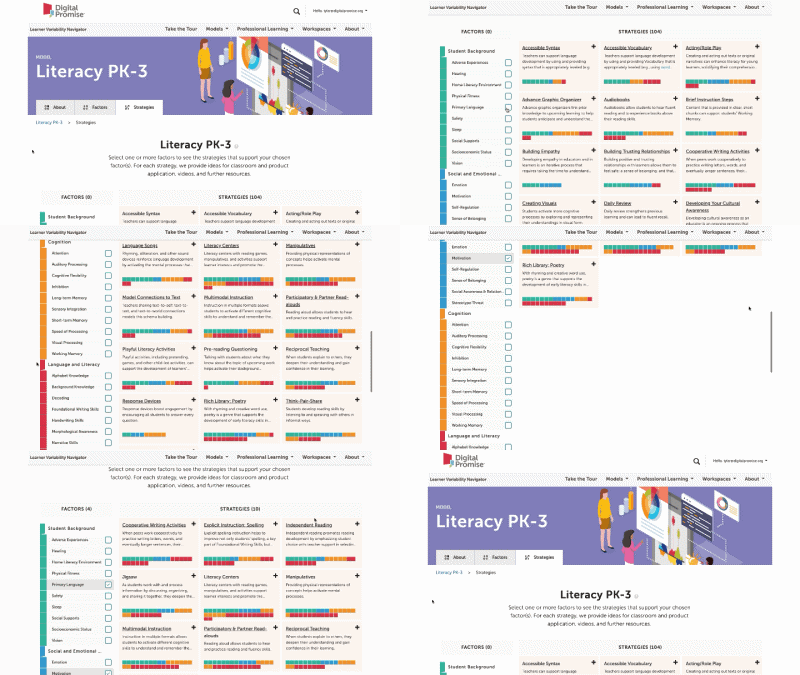
Adult learners who are struggling with Foundational Reading Skills, including decoding and phonemic awareness, can benefit from explicitly learning phonics skills in an educational setting.
Chou, M. H. (2014). Assessing English vocabulary and enhancing young English as a Foreign Language (EFL) learners' motivation through games, songs, and stories. Education 3-13, 42(3), 284-297.
Schneider, W. (2008). The development of metacognitive knowledge in children and adolescents: Major trends and implications for education. Mind, Brain, and Education, 2(3), 114-121.
Cornelius-White, J. (2007). Learner-centered teacher-student relationships are effective: A meta-analysis. Review of Educational Research, 77(1), 113-143.
Marley, S. C., & Carbonneau, K. J. (2014). Theoretical perspectives and empirical evidence relevant to classroom instruction with manipulatives. Educational Psychology Review, 26(1), 1-7.
Schmitt, S. A., Finders, J. K., & McClelland, M. M. (2015). Residential mobility, inhibitory control, and academic achievement in preschool. Early Education and Development, 26(2), 189-208.
Kucan, L., & Beck, I. L. (1997). Thinking aloud and reading comprehension research: Inquiry, instruction, and social interaction. Review of Educational Research, 67(3), 271-299.
Cromley, J. G., Du, Y., & Dane, A. P. (2020). Drawing-to-Learn: Does meta-analysis show differences between technology-based drawing and paper-and-pencil drawing?. Journal of Science Education and Technology, 29(2), 216-229.
Hymel, S., Schonert-Reichl, K. A., & Miller, L. (2006). Reading, ‘riting, ‘rithmetic and relationships: Considering the social side of education. Exceptionality Education Canada, 16(3), 1-44.
Tisdell, E. J. (2008). Critical media literacy and transformative learning: Drawing on pop culture and entertainment media in teaching for diversity in adult higher education. Journal of transformative education, 6(1), 48-67.
 Except where otherwise noted, content on this site is licensed under a Creative Commons Attribution-NonCommercial 4.0 International License


Already a user? LOG IN