Davis-Kean, P. E. (2005). The influence of parent education and family income on child achievement: The indirect role of parental expectations and the home environment. Journal of Family Psychology, 19(2), 294-304.
Gersten, R., Beckmann, S., Clarke, B., Foegen, A., Marsh, L., Star, J. R., & Witzel, B. (2009). Assisting students struggling with mathematics: Response to Intervention (RtI) for elementary and middle schools (NCEE 2009-4060). Washington, DC: National Center for Education Evaluation and Regional Assistance, Institute of Education Sciences, U.S. Department of Education.
Healy, L., Ramos, E. B., Fernandes, S. H. A. A., & Peixoto, J. L. B. (2016). Mathematics in the hands of deaf learners and blind learners: Visual-gestural-somatic means of doing and expressing mathematics. _In Mathematics Education and Language Diversity _(pp. 141-162). Springer, Cham.
the majority of the researchers agree that graphs and concept maps can be useful in selecting, encoding and organising information that leads to better remembering of the study materials (Robinson, Katayama, DuBois & DeVaney, 1998; Samarawickrema & O'Reilly, 2003). There is supporting evidence that organised and well-structured notes positively correlate with test scores and overall learning benchmarks in students (Titsworth & Kiewra, 1998, 2004). Titsworth (2004) argued that organisational cues of lecture notes enhance academic performance because they can help students to reduce their cognitive loads by providing determined note structures. Nevertheless, the outcomes of taking notes in a non-linear format highly depend on the actual technique used and the competence in utilising it.
Sutherland, K. S., Lewis-Palmer, T., Stichter, J., & Morgan, P. L. (2008). Examining the influence of teacher behavior and classroom context on the behavioral and academic outcomes for students with emotional or behavioral disorders. The Journal of Special Education, 41(4), 223-233.
Antia, S. D., Stinson, M. S., & Gaustad, M. G. (2002). Developing membership in the education of deaf and hard-of-hearing students in inclusive settings. Journal of Deaf Studies and Deaf Education, 7(3), 214-229.
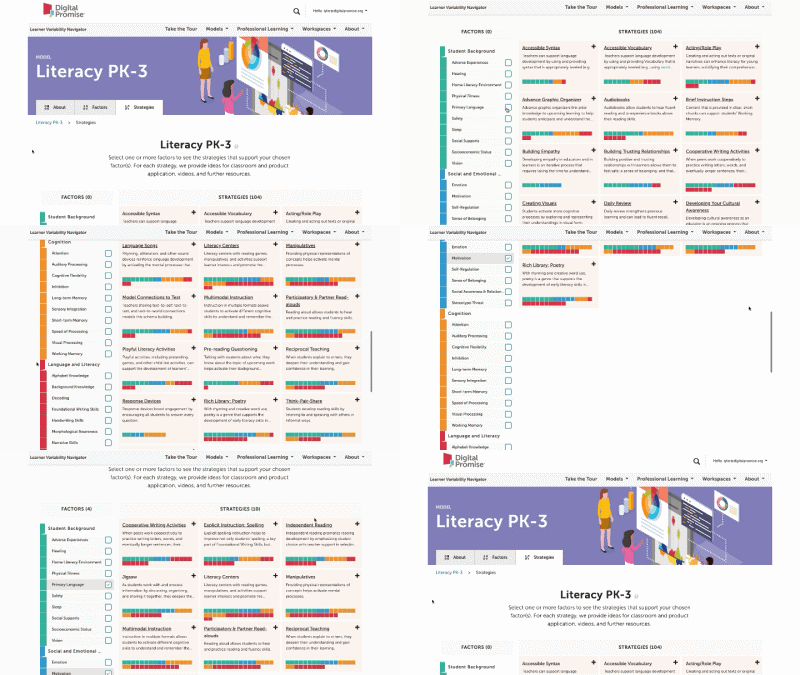
Additionally, using an advance graphic organizer prior to writing explicitly shows different ways to structure a text and reduces Working Memory load as students write.
Poetry is also a great resource to build social-emotional learning, especially with regards to Social Awareness & Relationship Skills.
Foran, L. M. (2009). Listening to music: Helping children regulate their emotions and improve learning in the classroom. educational HORIZONS, 88(1), 51-58.
Compton, D. L. (2002). The relationships among phonological processing, orthographic processing, and lexical development in children with reading disabilities. The Journal of Special Education, 35(4), 201-210.
 Except where otherwise noted, content on this site is licensed under a Creative Commons Attribution-NonCommercial 4.0 International License


Already a user? LOG IN