Cross, T. & Palese, K. (2015). Increasing learning: Classroom assessment techniques in the online classroom. American Journal of Distance Education, 29(2), 98–108.
O'Conner, R., De Feyter, J., Carr, A., Luo, J. L., & Romm, H. (2017). A review of the literature on social and emotional learning for students ages 3–8: What's Known Teacher and classroom strategies that contribute to social and emotional learning (part 3 of 4). Washington, D.C.: Institute of Education Sciences, Department of Education.
Cain, K. (2007). Syntactic awareness and reading ability: Is there any evidence for a special relationship? Applied Psycholinguistics, 28(4), 679-694.
Boutte, G.S., Lopez-Robertson, J. & Powers-Costello, E. (2011). Moving beyond colorblindness in early childhood classrooms. Early Childhood Education Journal, 39, 335
Alegre, F., Moliner, L., Maroto, A., & Lorenzo-Valentin, G. (2018). Peer tutoring in mathematics in primary education: A systematic review. Educational Review, 1-26.
Cohen, J. (2001). Social and emotional education: Core concepts and practices. In J. Cohen (Ed.), Caring classrooms/intelligent schools: The social emotional education of young children (Chapter 1). New York, NY: Teachers College Press.
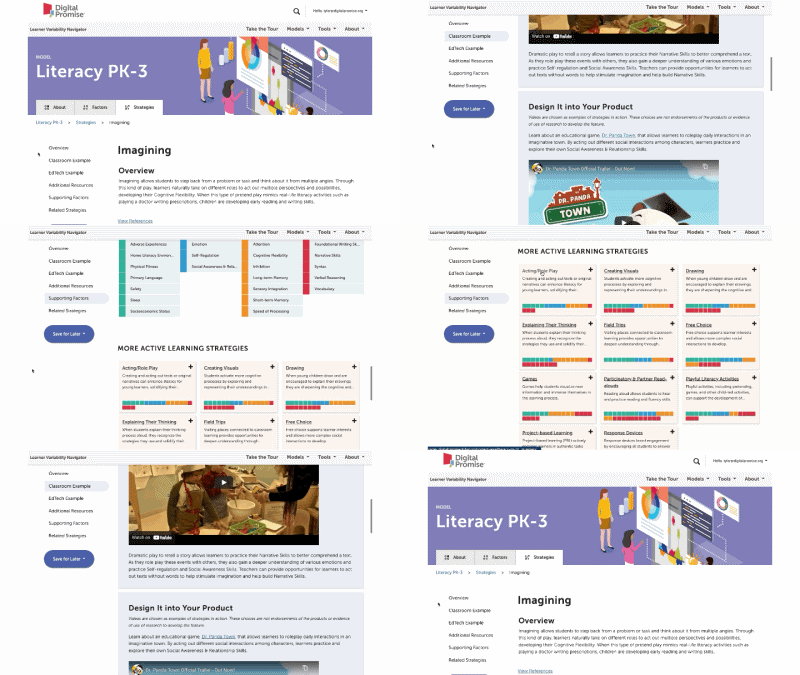
Encouraging learners to draw as a form of synthesizing key concepts and to explain their drawings in the classroom, can support the development of Core Academic Literacies, especially when solving complex problems across content areas.
Kamil, M. L., Borman, G. D., Dole, J., Kral, C. C., Salinger, T., & Torgesen, J. (2008). Improving adolescent literacy: Effective classroom and intervention practices . Washington, DC: National Center for Education Evaluation and Regional Assistance, Institute of Education Sciences, U.S. Department of Education.
Education Endowment Foundation. (2018). Collaborative learning: Moderate impact for very low cost, based on extensive evidence. Teaching & learning toolkit. Retrieved from https://educationendowmentfoundation.org.uk/pdf/generate/?u=https://educationendowmentfoundation.org.uk/pdf/toolkit/?id=152&t=Teaching%20and%20Learning%20Toolkit&e=152&s=
Sutherland, K. S., Lewis-Palmer, T., Stichter, J., & Morgan, P. L. (2008). Examining the influence of teacher behavior and classroom context on the behavioral and academic outcomes for students with emotional or behavioral disorders. The Journal of Special Education, 41(4), 223-233.
 Except where otherwise noted, content on this site is licensed under a Creative Commons Attribution-NonCommercial 4.0 International License


Already a user? LOG IN