Given the robust nature of learning sciences research, this website is best viewed on tablets and computers. A small screen experience is coming in the future.
On June 22, 2021, we will launch updated strategies for the Math PK-2 model, as well as additional updates to the Navigator that highlight equity, SEL, and culturally responsive teaching. To learn more, visit our Site Updates (available in the "About" menu at the top of any page).
Hover to see how factors connect to Civic Mindedness. Then click connected factors to explore strategies related to multiple factors.
A learner's Civic Mindedness involves seeing oneself as a contributor to their community, being informed and empowered to help or include others, and joining with others to achieve common goals for the community. This means being attuned to, respecting, and beginning to identify the needs and goals (e.g. social or environmental issues) of the people in one's community while recognizing that they may be different from their own. It entails thinking critically about civic content knowledge (including social movements), about the democratic systems which govern learners' communities, the injustices and disparities these systems may create for themselves and others, and the process of thinking about and contributing to solutions. Adolescents' critical consciousness—their confidence and ability to reflect, engage, and act on social issues—is a source of empowerment, and can contribute to academic engagement and outcomes, especially for learners from historically and systematically excluded groups.
Environments that allow time for open-ended discussion and activity with peers provide informal opportunities for civic actions, with students learning to form communal goals, care for each other, and resolve disputes. As students progress through school they begin to try out their civic participation in both formal and informal learning contexts. An open classroom climate can empower learners in shared decision making about their class. In addition, encouraging learners to question norms and supporting them with the language and opportunities to engage in difficult conversations about injustice can empower them as learners and community members, engaging and growing their Civic Mindedness.
A learner's Civic Identity is grounded in having a sense of self as part of a larger whole. A learner's exploration of their Identities and values is key to guiding their actions in their communities and developing Civic Mindedness. That is, learners must have both a sense of personal agency and self-efficacy, the ability and initiative to act, and Social Awareness of the other individuals in the community. With this they can begin to recognize the needs and opportunities of others in their community, a sense of responsibility, and the initiative to collaboratively effect change. This includes acting on behalf of others in one's community, as well as acting in Collaboration with others. When students are given the freedom to care for each other and their community, they also learn to live as a member of a community, fostering a Sense of Belonging. The development of Civic Mindedness in the classroom relies on establishing a sense of community and trust with teachers and classmates, and active participation in the classroom. Therefore it is important to consider the impact of "pull-out" vs. "push-in” services for students who need extra learning support-- including multilingual language learners and those with learning disabilities or ADHD as it may affect their ability to actively engage with their classroom community the same way as their peers.
Students' communities provide a natural context for learning that matters to learners, and so connecting the community to the classroom provides students a real world context to think critically and creatively to solve problems that affect them. As such, integrating community, for instance with service learning or youth action research projects, promotes active and inclusive engagement in the classroom, neighborhood, and the broader world.
Social Responsibility--a sense of obligation to contribute to the greater good--is a value that affects our beliefs and how we interact with others, and is a motivator of many civic actions. It is related to empathy, prosocial behaviors, and general care for others with an emphasis on positive social change. During childhood and adolescence, the developmental roots of individuals' social responsibility lie in the growth of cognitive skills, Emotion regulation, empathy, and Identity. In order to foster learners' social responsibility in their everyday lives, educators can model prosocial behaviors, communicate care and concerns for others, and provide opportunities to practice civic skills. In addition, parents, teachers, and schools should instill social responsibility in students through civic discussions and role modeling. In particular, adults should discuss the root causes of social issues with adolescents. Organized activities that include opportunities to take on leadership positions, work as a team, and connect with the broader community provide an excellent venue for high school students' civic character development.
As learners work together to solve problems, they learn new strategies and practice Communication skills as they express their academic thinking.
Physical activity and recess refer to designated times and activities that allow students to engage in movement, play, and exercise, promoting physical and mental well-being.
Physical activity and recess in early childhood provides social, physical, and mental benefits to learners.
Self-advocacy is the ability of an individual to understand and effectively express and assert their own rights, needs, desires, and interests.
Discussing race with students can range from conversations on cultural celebration (e.g., celebrating the importance of diversity) to developing critical consciousness (e.g., understanding the impact of social inequities like racism and how to dismantle it).
Translanguaging is a flexible classroom practice enabling students to listen, speak, read, and write across their multiple languages or dialects, even if the teacher does not have formal knowledge of these additional languages.
Developing empathy in educators and in learners is an iterative process that requires taking the time to understand and honor others' perspectives.
Simulations involve students engaging in interactive experiences that mimic real-world scenarios to explore content, practice skills, and solve problems.
Socratic seminar refers to a discussion technique that engages learners in the exploration of content through Critical Thinking and classroom dialogue in order to help learners make meaning from what they are learning.
Youth participatory action research (YPAR) is a student-centered approach that puts the learner at the helm of the research process, from ideation to dissemination, to investigate and advocate for change they want to see in their schools and communities.
An open classroom climate is an educational environment where students feel comfortable and confident expressing their opinions in class.
Spaced practice is a learning strategy that deliberately spaces out learning or study sessions over varying periods of time, with the purpose of increasing retention, understanding, and long-term knowledge acquisition.
Retrieval practice requires students to access information, or get information “out” from Long-term memory in order to support better retention and understanding.
Lateral reading refers to a specific type of media literacy used by professional fact-checkers to ascertain the credibility of digital information.
Building positive and trusting relationships with learners fosters a Sense of Belonging, safety, and engagement, laying the groundwork for academic, cognitive, and social-emotional growth.
Except where otherwise noted, content on this site is licensed under a Creative Commons Attribution-NonCommercial 4.0 International License

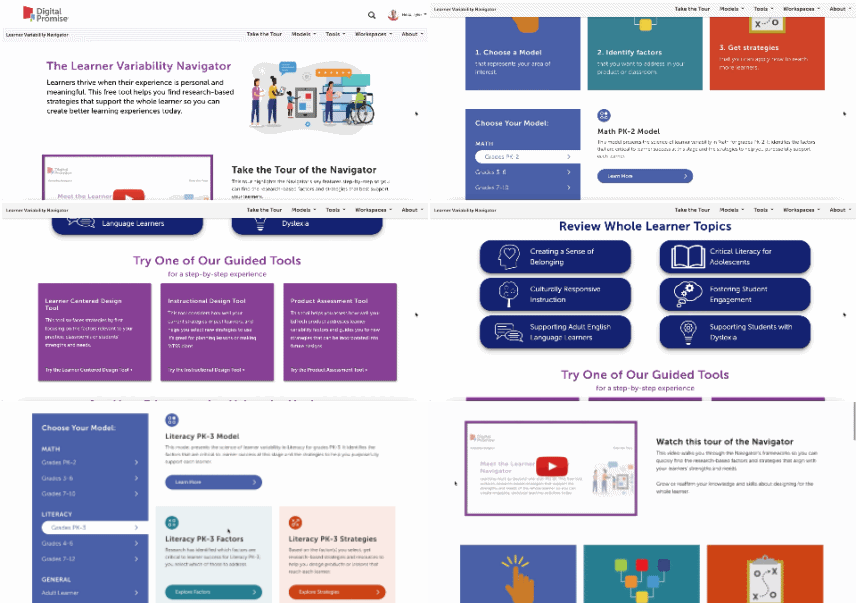
This is our homepage. You can access many of the features of the Navigator here, and learn more about how learner variability intersects with topics in education and learning. To start, select a content area – we call them Learner Models – to visit a factor map.
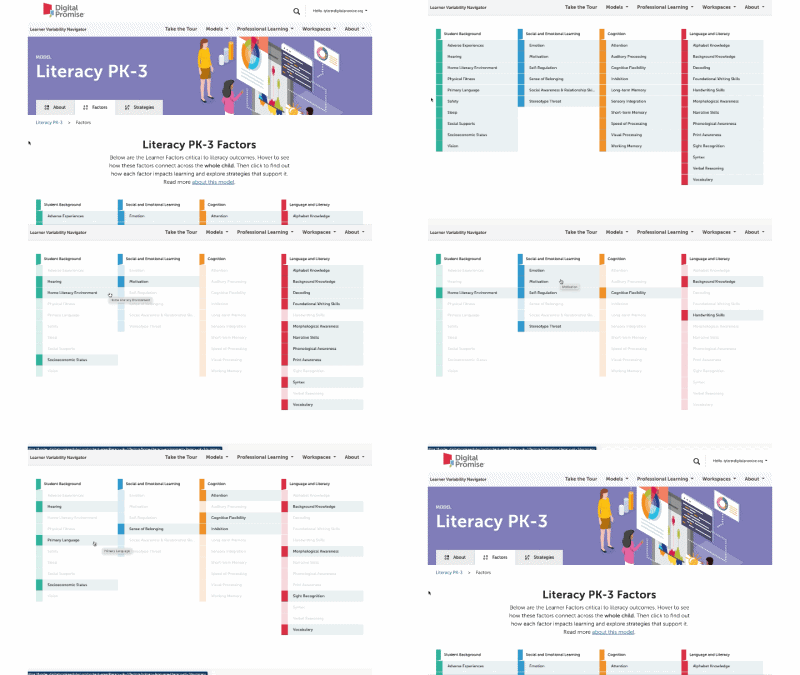
Factor maps show research-based concepts, "factors," that likely impact learning. They are organized into four categories: Learner Background, Social and Emotional Learning, Cognition, and Content Area. The map is interactive. Move your cursor over a factor to see connected factors. Select any factor to visit its summary page. We'll look at factor summary pages next.
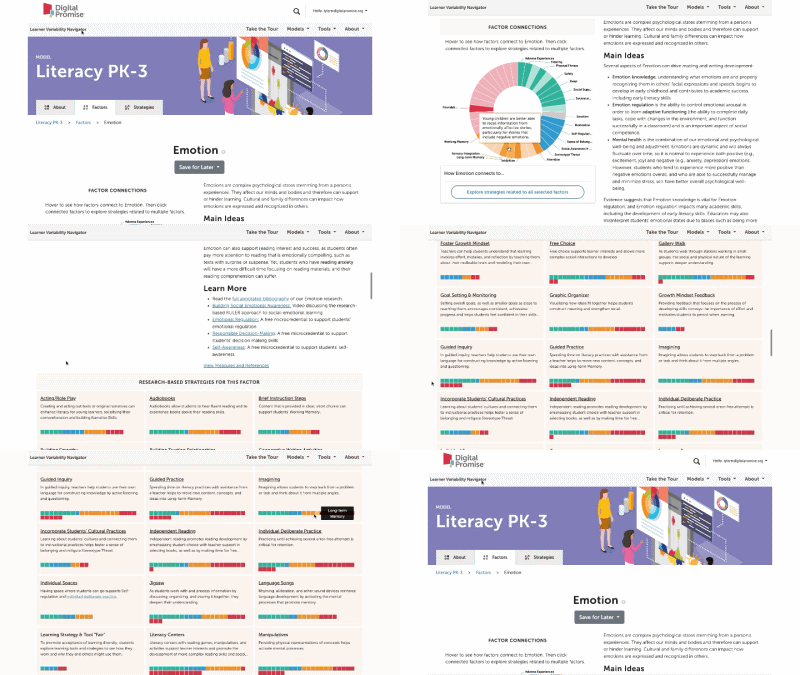
This is a factor summary page. It provides a brief definition and review of the factor, a factor connections diagram, additional resources, and strategies that support this factor. On the strategy card, the multi-colored boxes show all the factors that it supports. Select a strategy to visit its summary page.
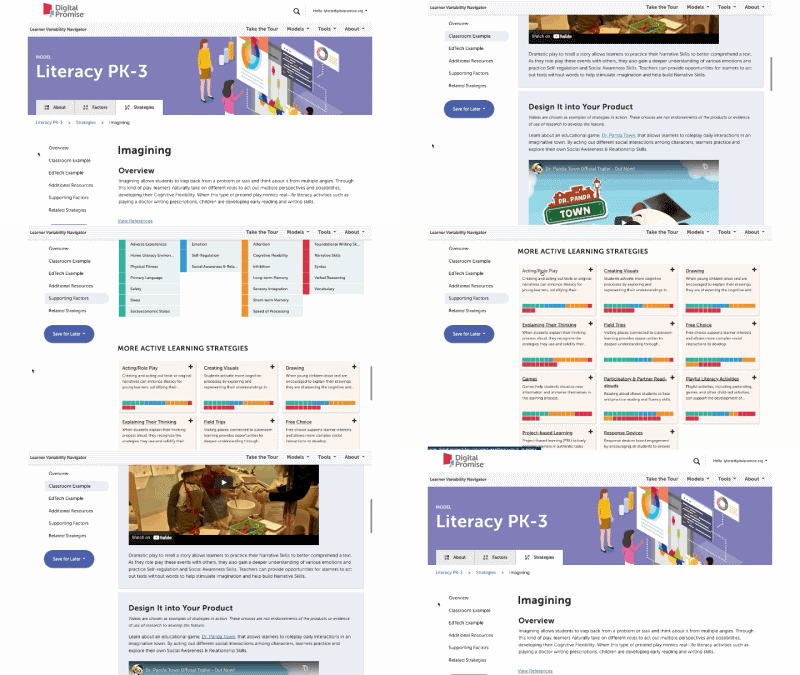
Strategy summary pages have an overview, information about using the strategy in different learning environments, resources of interest, the factors this strategy supports, and related strategies you can explore. To view all the strategies in a content area, use the strategies tab at the top of the page. We'll look at all the Strategies for this learner model next.
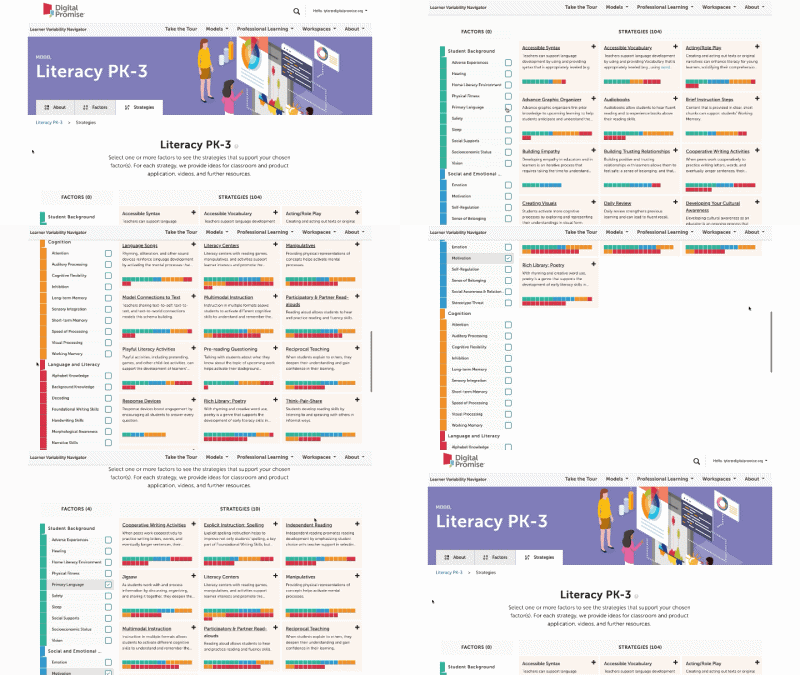
The strategy page shows ALL of the strategies for that learner model. You can select factors of interest for you or your learners, and it will narrow the strategies to only those that match all of the factors selected. This makes it easy to find key strategies to better design for learner variability. Again, select the strategy name to visit its summary page.
Are you sure you want to delete this Workspace?
Enter the email address of the person you want to share with. This person will be granted access to this workspace and will be able to view and edit it.
Adjust the permissions of your Workspace.
This Workspace is .
This Workspace's Reflection Area is .
Learner variability is the recognition that each learner is a unique constellation of strengths and challenges that are interconnected across the whole child. Understanding these connections and how they vary according to context is essential for meeting the needs of each learner.
It disrupts the notion of a one-size-fits all education. Understanding learner variability helps educators embrace both students’ struggles and strengths as we connect practice to uplifting the whole learner.
Throughout the site, we talk about "factors" and "strategies." Factors are concepts research suggests have an impact on how people learn. Strategies are the approaches to teaching and learning that can be used to support people in how they learn best.
Use the Learner Centered Design Tool to build a workspace. Go to Learner Centered Design Tool.
Or, create a new blank workspace for your product or project.
Use one of the guided tools to build a workspace.
Or, create a new blank workspace for your product or project.
Make a copy of this workspace.
Redirecting soon...
Generating summary page
Loading...
On this page, using your heatmap, you will be asked to select factors to further explore, and then select new strategies you might incorporate into upcoming instruction. Once done, click “Show Summary" to view your Design Summary Report.
On this page, using your heatmap, you will be asked to select factors to further explore, and then select new strategies you might incorporate into upcoming instruction. Once done, click “Show Report” to view your Design Summary Report.
By selecting "Show Report" you will be taken to the Assessment Summary Page. Once created, you will not be able to edit your report. If you select cancel below, you can continue to edit your factor and strategy selections.
Announcement here
Item successfully added to workspace!
Issue adding item to workspace. Please refresh the page and try again.
Learner variability is the recognition that each learner is a unique constellation of strengths and challenges that are interconnected across the whole child. Understanding these connections and how they vary according to context is essential for meeting the needs of each learner. It embraces both students’ struggles and strengths. It considers the whole child.
Throughout the site, we talk about "factors" and "strategies." Factors are concepts research suggests have an impact on how people learn. Strategies are the approaches to teaching and learning that can be used to support people in how they learn best.
The Learner Variability Navigator is a free, online tool that translates the science of learner variability into factor maps and strategies that highlight connections across the whole learner. This puts the science of learning at teachers' fingertips, empowering them to understand their own practice and support each learner.