Effective use of case-based learning provokes rich discussion and helps deepen learners' awareness of their diverse community of learners.
Products can also enable educators to provide timely feedback and guidance during guided inquiry, such as providing learners with explanations, clarifications, hints or nudges, as well as correcting misconceptions that the learner may demonstrate.
Research shows that, along with traditional reading comprehension strategies, learners use unique strategies to read the non-linear, hyperlinked structure of online texts.
In addition, Physical Well-being, including exercise, may be particularly important for those learners with ADHD as it can support cognition, mood, and focus.
Implementation varies substantially and results in differential effects with adult learners based on their Background Knowledge, previous educational experiences, Self-Regulation, and Learner Mindset.
When educators integrate the cultural knowledge learners bring to the learning environment into mathematical problems and projects, they help learners draw on their background knowledge to better understand and relate to the material.
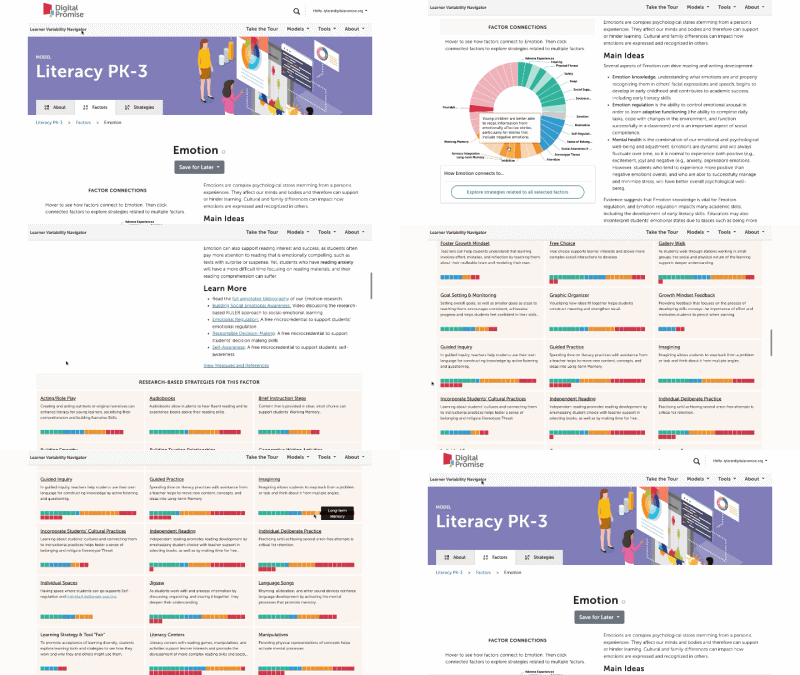
Students from diverse backgrounds and cultures, as well as students with learning disorders or ADHD, may have ways of expressing their Emotions, perceiving Emotions in others, and reacting to Emotions that differ from what we'd expect to see from learners.
Burt, M., Peyton, J. K., & Schaetzel, K. (2008). Working with adult English language learners with limited literacy: Research, practice, and professional development. Washington, DC: Center for Applied Linguistics. Retrieved September 12, 2008.
Unfortunately, since bilingual/multilingual learners' language development in the early grades is typically less well understood, these learners are paradoxically both less likely to be identified as in need of special education services where they may need them and over-identified as needing special education services when they do not.
Using audiobooks or e-books coupled with printed texts has been shown to greatly benefit literacy outcomes for struggling readers, including an increased Motivation for reading, especially for learners with dyslexia and multilingual learners.
 Except where otherwise noted, content on this site is licensed under a Creative Commons Attribution-NonCommercial 4.0 International License


Already a user? LOG IN