Lin, Yi-Yin (2020). Support matters: Predictors of intrinsic motivation in older learners in Taiwan. Australian Journal of Adult Learning, 60(2), 190-212.
In our society, there are many stereotypes that exist about the academic abilities of learners based on characteristics such as their race, gender, disability, and socioeconomic status.
Baker, S., Lesaux, N., Jayanthi, M., Dimino, J., Proctor, C. P., Morris, J., Gersten, R., Haymond, K., Kieffer, M. J., Linan-Thompson, S., & Newman-Gonchar, R. (2014). Teaching academic content and literacy to English learners in elementary and middle school (NCEE 2014-4012). Washington, DC: National Center for Education Evaluation and Regional Assistance (NCEE), Institute of Education Sciences, U.S. Department of Education.
Math Mindset includes learners' self-concept and self-efficacy beliefs as well as their mindset toward failure, all of which shape their willingness to get involved with mathematics.
Math Mindset includes learners' self-concept and self-efficacy beliefs as well as their mindset toward failure, all of which shape their willingness to get involved with mathematics.
Through guided practice, learners rephrase, elaborate, summarize, recall, and question new content, leading to sufficient rehearsal for deeper learning.
Hunter, W. C., Barnes, K. L., Taylor, A., Rush, C., & Banks, T. (2021). Using flexible grouping instruction to create culturally relevant PK-12 learning communities for culturally and linguistically diverse learners with exceptionalities. Multicultural Learning and Teaching, 0(0).
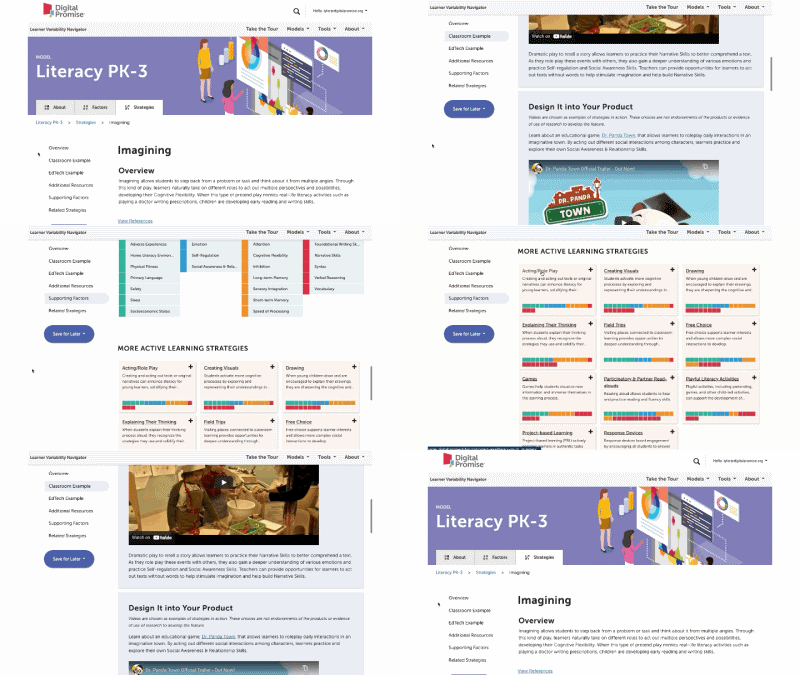
Visual representations allow learners to exhibit what they know and can do in alternative ways that can support Working Memory during problem solving and retention of information in Long-term Memory.
Visual representations allow learners to exhibit what they know and can do in alternative ways that can support Working Memory during problem solving and retention of information in Long-term Memory.
Visual representations allow learners to exhibit what they know and can do in alternative ways that can support Working Memory during problem solving and retention of information in Long-term Memory.
 Except where otherwise noted, content on this site is licensed under a Creative Commons Attribution-NonCommercial 4.0 International License


Already a user? LOG IN