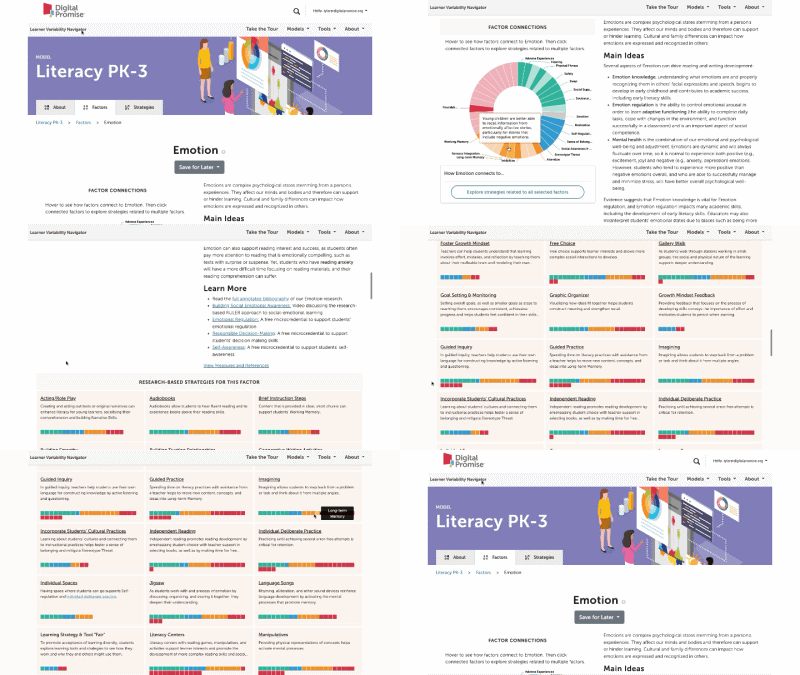
Literacy centers with reading games, manipulatives, and activities support learner interests and promote the development of more complex reading skills and social interactions.
This type of support can be especially beneficial for those learners with dysgraphia or dyspraxia who may have difficulties with handwriting or spelling, as removing the act of physically writing or typing allows learners to express ideas freely without the constraints of conventional writing, and frees up Working Memory to support content generation.
Coleman, R., & Goldenberg, C. (2009). What does research say about effective practices for English learners? Introduction and part I: Oral language proficiency. Kappa Delta Pi Record, 46(1), 10-16.
Coleman, R., & Goldenberg, C. (2009). What does research say about effective practices for English learners? Introduction and part I: Oral language proficiency. Kappa Delta Pi Record, 46(1), 10-16.
Chaffin, A. J., & Harlow, S. D. (2005). Cognitive learning applied to older adult learners and technology. Educational Gerontology, 31(4), 301-329.
To support learners in identifying important information from word problems, products can provide screengrab examples where learners can watch as key words are coded and irrelevant information is crossed out.
Through Peer-Assisted Learning Strategies (PALS), learners alternate in performing a literacy activity and sharing their thoughts with a partner by taking on the roles of a coach and player.
Back, M., Han, M., & Weng, S. C. (2020). Emotional scaffolding for emergent multilingual learners through translanguaging: Case stories. Language and education, 34(5), 387-406.
These programs, which can serve as assistive technology for learners with writing difficulties, support all learners by allowing them to focus on the content of their composition.
With verbal repetition, learners also can personalize and interact with information, activating multiple brain pathways to move knowledge from Short- to Long-term Memory.
 Except where otherwise noted, content on this site is licensed under a Creative Commons Attribution-NonCommercial 4.0 International License


Already a user? LOG IN