Antia, S. D., Kreimeyer, K. H., Metz, K. K., & Spolsky, S. (2003). Peer interactions of deaf and hard-of-hearing children. Oxford Handbook of Deaf Studies, Language, and Education, 1, 164-176.
Lopez, S. J., & Louis, M. C. (2009). The principles of strengths-based education. Journal of College and Character, 10(4).Lopez, F. A. (2017). Altering the trajectory of the self-fulfilling prophecy: Asset-based pedagogy and classroom dynamics. Journal of Teacher Education, 68(2), 193-212.
Immordino-Yang, M. H. (2016). Emotion, sociality, and the brain's default mode network: Insights for educational practice and policy. Policy Insights from the Behavioral and Brain Sciences, 3(2), 211-219.
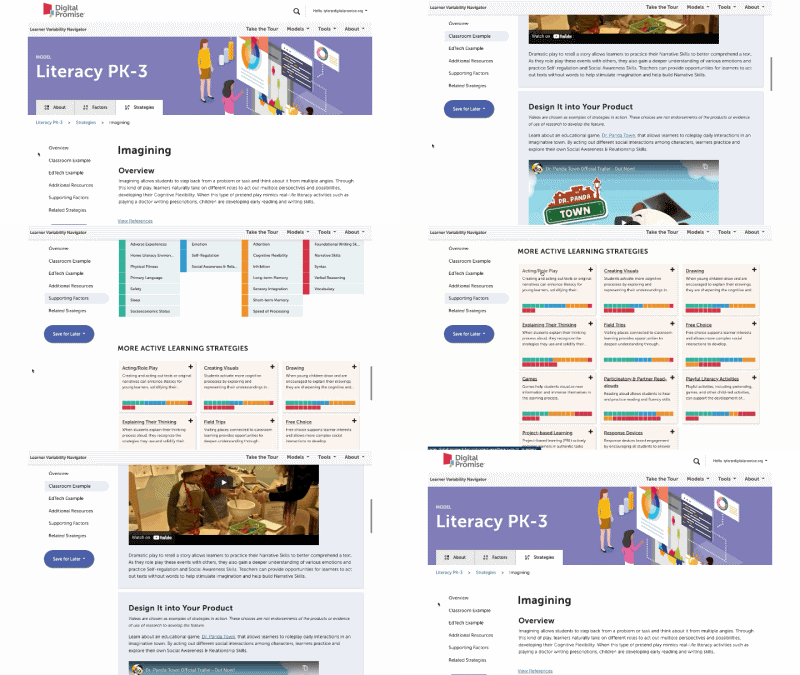
Product developers can incorporate free choice into their products by providing a range of open-ended activities, virtual manipulatives or free-play zones with resource libraries that include visuals, sounds and other features that users can choose from.
Education Endowment Foundation. (2018). Collaborative learning: Moderate impact for very low cost, based on extensive evidence. Teaching & learning toolkit. Retrieved from https://educationendowmentfoundation.org.uk/pdf/generate/?u=https://educationendowmentfoundation.org.uk/pdf/toolkit/?id=152&t=Teaching%20and%20Learning%20Toolkit&e=152&s=
Roskos, K.A., Christie, J.F., Richgels, D.J. (2003). The essentials of early literacy instruction. Report from the National Association for the Education of Young Children.
By learning more about students' Learning Environments, educators can better understand and build learning around the rich funds of knowledge and skills students bring with them.
Star, J. R., Caronongan, P., Foegen, A., Furgeson, J., Keating, B., Larson, M. R., Lyskawa, J., McCallum, W. G., Porath, J., & Zbiek, R. M. (2015). Teaching strategies for improving algebra knowledge in middle and high school students. Washington, DC: National Center for Education Evaluation and Regional Assistance (NCEE).
Gielen, S., Tops, L., Dochy, F., Onghena, P., & Smeets, S. (2010). A comparative study of peer and teacher feedback and of various peer feedback forms in a secondary school writing curriculum. British educational research journal, 36(1), 143-162.
O'Conner, R., De Feyter, J., Carr, A., Luo, J. L., & Romm, H. (2017). A review of the literature on social and emotional learning for students ages 3–8: What's Known Teacher and classroom strategies that contribute to social and emotional learning (part 3 of 4). Washington, D.C.: Institute of Education Sciences, Department of Education.
 Except where otherwise noted, content on this site is licensed under a Creative Commons Attribution-NonCommercial 4.0 International License


Already a user? LOG IN