Schneider, M., Grabner, R. H., & Paetsch, J. (2009). Mental number line, number line estimation, and mathematical achievement: Their interrelations in grades 5 and 6. Journal of Educational Psychology, 101(2), 359–372.
Medwell, J., & Wray, D. (2014). Handwriting automaticity: the search for performance thresholds. Language and Education, 28(1), 34-51.
Brozo, W., & Crain, S. (2018). Writing in math: A disciplinary literacy approach. The Clearing House: A Journal of Educational Strategies, Issues and Ideas, 91(1), 7-13.
Star, J. R., Caronongan, P., Foegen, A., Furgeson, J., Keating, B., Larson, M. R., Lyskawa, J., McCallum, W. G., Porath, J., & Zbiek, R. M. (2015). Teaching strategies for improving algebra knowledge in middle and high school students. Washington, DC: National Center for Education Evaluation and Regional Assistance (NCEE).
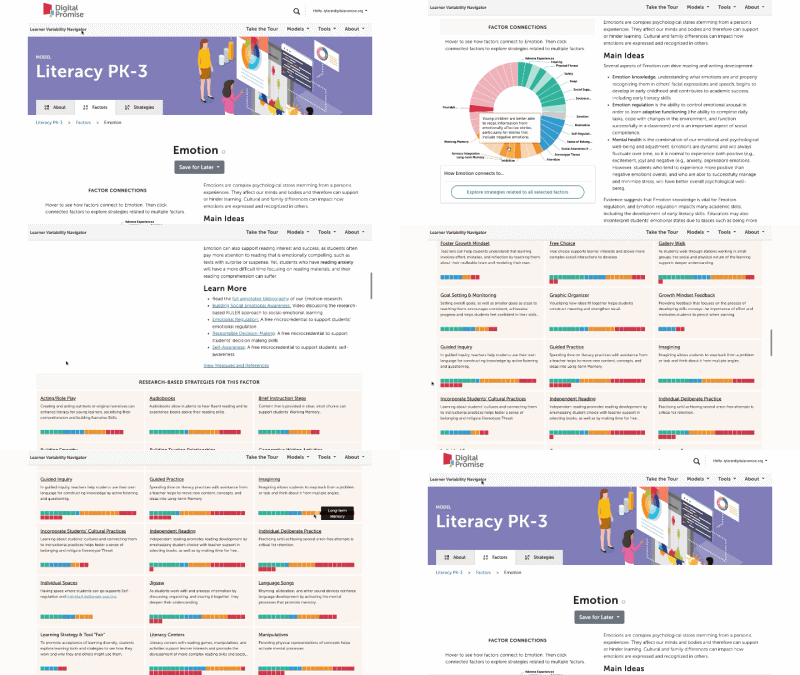
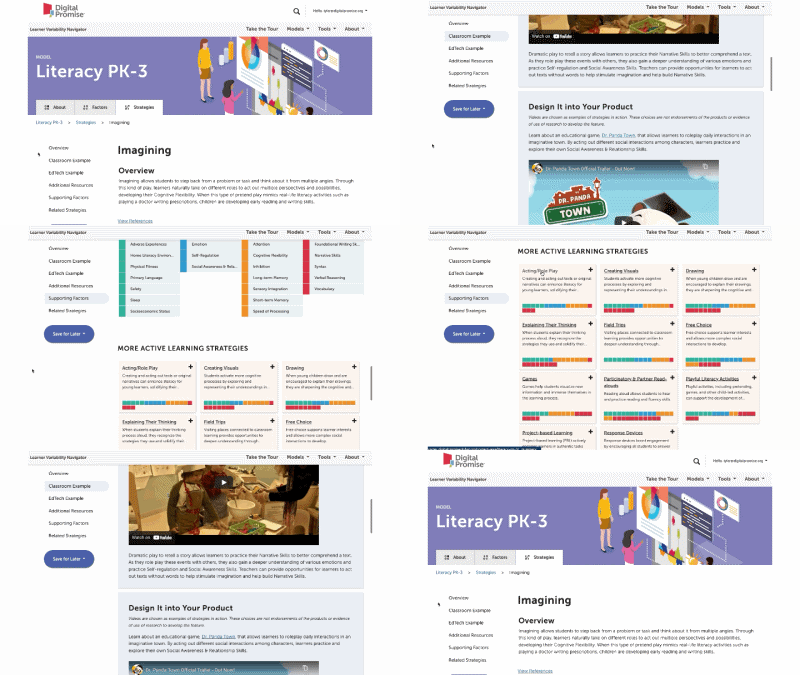
Explaining their thinking can be especially helpful for those learners with lower levels of Background Knowledge as these processes help encourage more involved interaction with a variety of texts and resources.
Maloney, E. A., Schaeffer, M. W., & Beilock, S. L. (2013). Mathematics anxiety and stereotype threat: shared mechanisms, negative consequences and promising interventions. Research in Mathematics Education, 15(2), 115-128.
Kaur, H. (2015). Two aspects of young children's thinking about different types of dynamic triangles: Prototypicality and inclusion. ZDM: The International Journal on Mathematics Education, 47(3), 407–420.
Lee, K., Ng, E. L., & Ng, S. F. (2009). The contributions of working memory and executive functioning to problem representation and solution generation in algebraic word problems. Journal of Educational Psychology, 101(2), 373–387.
García Franco, A., Ferrara Reyes, L., & Gómez Galindo, A. A. (2022). Culturally relevant science education and critical thinking in indigenous people: bridging the gap between community and school science. Critical Thinking in Biology and Environmental Education: Facing Challenges in a Post-Truth World, 55-72.
Tare, M., Shell, A. R., & Jackson, S. R. (2020). Student engagement with evidence-based supports for literacy on a digital platform. Journal of Research on Technology in Education, 1-11.
 Except where otherwise noted, content on this site is licensed under a Creative Commons Attribution-NonCommercial 4.0 International License


Already a user? LOG IN