Havik, T., & Westergard, E. (2020). Do teachers matter? Students' perceptions of classroom interactions and student engagement. Scandinavian Journal of Educational Research, 64(4), 488-507
Jagers, R. J., Rivas-Drake, D., & Williams, B. (2019). Transformative social and emotional learning (SEL): Toward SEL in service of educational equity and excellence. Educational Psychologist, 54(3), 162-184.
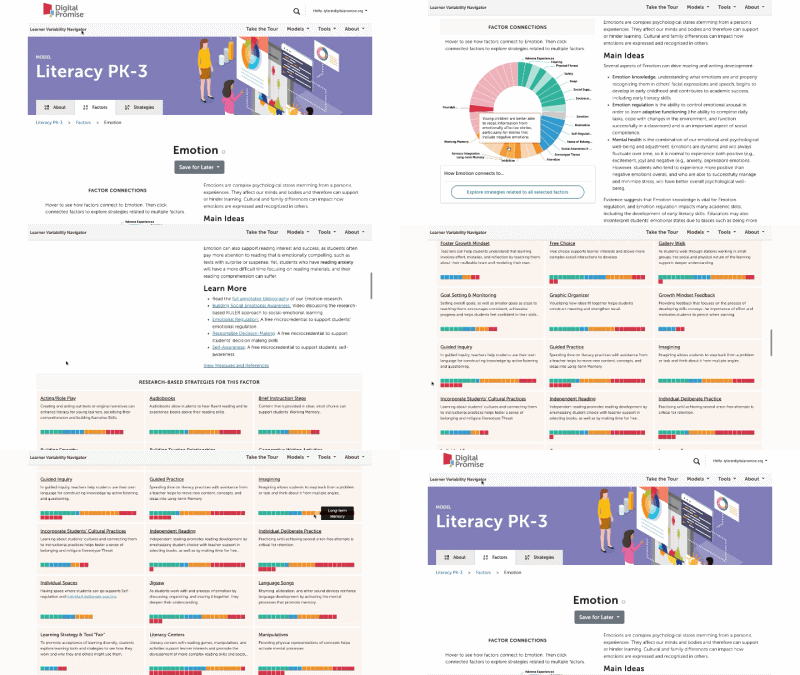
Conducting read-alouds with books that focus on emotions allows students to safely practice identifying and labelling emotions.
Albright, L. K. (2002). Bringing the ice maiden to life: Engaging adolescents in learning through picture book read-alouds in content areas. Journal of Adolescent & Adult Literacy, 45(5), 418-428.
Gersten, R., Beckmann, S., Clarke, B., Foegen, A., Marsh, L., Star, J. R., & Witzel, B. (2009). Assisting students struggling with mathematics: Response to Intervention (RtI) for elementary and middle schools (NCEE 2009-4060). Washington, DC: National Center for Education Evaluation and Regional Assistance, Institute of Education Sciences, U.S. Department of Education.
Shepard, L. A., Penuel, W. R., & Pellegrino, J. W. (2018). Using learning and motivation theories to coherently link formative assessment, grading practices, and large-scale assessment. Educational measurement: Issues and Practice, 37(1), 21-34.
Alloway, T.P. (2006). How does working memory work in the classroom? Educational Research and Reviews, 1(4), 134-139.
Prion, S., & Mitchell, M. (2008). Audiobooks and cognitive load. In C. Bonk, M. Lee, & T. Reynolds (Eds.), Proceedings of e-learn: World conference on e-learning in corporate, government, healthcare, and higher education 2008 (pp. 1917-1926). Chesapeake, VA: Association for the Advancement of Computing in Education (AACE). Retrieved from https://www.learntechlib.org/p/29923
Alloway, T.P. (2006). How does working memory work in the classroom? Educational Research and Reviews, 1(4), 134-139.
Florida Department of Education. (2010). Classroom cognitive and meta-cognitive strategies for teachers: Research-based strategies for problem-solving in mathematics K-12. Tallahassee, FL: Bureau of Exceptional Education and Student Services, Florida Department of Education.
 Except where otherwise noted, content on this site is licensed under a Creative Commons Attribution-NonCommercial 4.0 International License


Already a user? LOG IN