Developing empathy in educators and in learners is an iterative process that requires taking the time to understand and honor others' perspectives.
Berne, J. (2004). Think-aloud protocol and adult learners. Adult Basic Education, 14(3), 153.
Developing empathy in educators and in learners is an iterative process that requires taking the time to understand and honor others' perspectives.
Developing empathy in educators and in learners is an iterative process that requires taking the time to understand and honor others' perspectives.
Developing empathy in educators and in learners is an iterative process that requires taking the time to understand and honor others' perspectives.
Developing empathy in educators and in learners is an iterative process that requires taking the time to understand and honor others' perspectives.
Capell, M. (2016). Interweaving letters and sounds: The impact of phonics instruction in English on the oral production and symbolic representation of sounds among university-level L2 English learners. [Unpublished master's thesis]. Universidad Nacional De Córdoba Facultad De Lenguas.
Healy, L., Ramos, E. B., Fernandes, S. H. A. A., & Peixoto, J. L. B. (2016). Mathematics in the hands of deaf learners and blind learners: Visual–gestural–somatic means of doing and expressing mathematics. In Mathematics Education and Language Diversity (pp. 141-162). Springer, Cham.
Healy, L., Ramos, E. B., Fernandes, S. H. A. A., & Peixoto, J. L. B. (2016). Mathematics in the hands of deaf learners and blind learners: Visual–gestural–somatic means of doing and expressing mathematics. In Mathematics Education and Language Diversity (pp. 141-162). Springer, Cham.
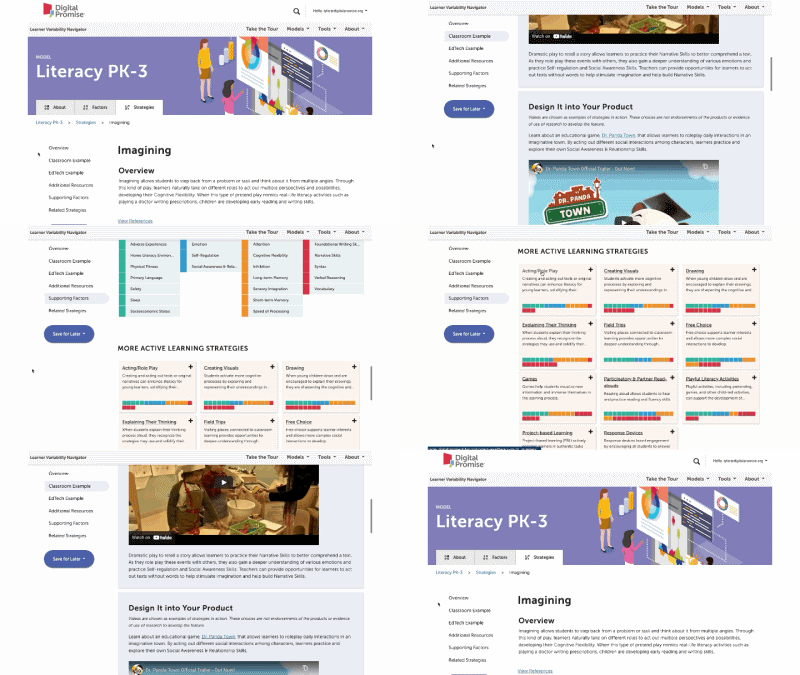
Providing a story map ahead of time or having students create a map during or after reading helps learners understand and practice Narrative Skills.
 Except where otherwise noted, content on this site is licensed under a Creative Commons Attribution-NonCommercial 4.0 International License


Already a user? LOG IN