Immordino-Yang, M. H., & Damasio, A. (2007). We feel, therefore we learn: The relevance of affective and social neuroscience to education. Mind, Brain, and Education, 1(1), 3–10. https://doi.org/10.1111/j.1751-228X.2007.00004.x
Barrett, J. E., Clements, D. H., Klanderman, D., Pennisi, S.-J., & Polaki, M. V. (2006). Students' coordination of geometric reasoning and measuring strategies on a fixed perimeter task: Developing mathematical understanding of linear measurement. Journal for Research in Mathematics Education, 37(3), 187-221.
Flipped classrooms can be “fully flipped” which provides all lecture materials outside of the class and is modeled after higher education courses, or “partially flipped'', when educators provide materials for review outside of class but spend time in class helping learners synthesize their understanding before engaging in class activities.
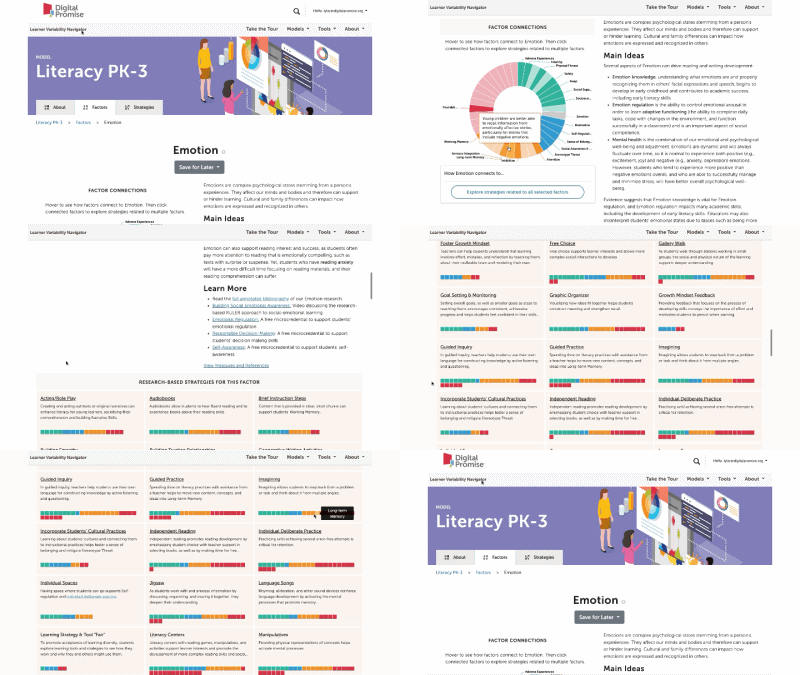
Immordino-Yang, M.H. (2016). Emotion, sociality, and the brain's default mode network: Insights for educational practice and policy. Policy Insights from the Behavioral and Brain Sciences, 3(2), 211–219.
Norton, M. (2001). Getting our own education: Peer tutoring and participatory education in an adult literacy centre. Participatory practices in adult education, 103-120.
Education Endowment Foundation. (2018). Collaborative learning: Moderate impact for very low cost, based on extensive evidence. Teaching & learning toolkit. Retrieved from https://educationendowmentfoundation.org.uk/pdf/generate/?u=https://educationendowmentfoundation.org.uk/pdf/toolkit/?id=152&t=Teaching%20and%20Learning%20Toolkit&e=152&s=
Joseph, N. (2009). Metacognition needed: Teaching middle and high school students to develop strategic learning skills. Preventing School Failure: Alternative Education for Children and Youth, 54(2), 99-103.
Gersten, R., Beckmann, S., Clarke, B., Foegen, A., Marsh, L., Star, J. R., & Witzel, B. (2009). Assisting students struggling with mathematics: Response to Intervention (RtI) for elementary and middle schools (NCEE 2009-4060). Washington, DC: National Center for Education Evaluation and Regional Assistance, Institute of Education Sciences, U.S. Department of Education.
Gardner, T. J. (2008). Speech recognition for students with disabilities in writing. Physical Disabilities: Education and Related Services, 26(2), 43-53.
Gardner, T. J. (2008). Speech recognition for students with disabilities in writing. Physical Disabilities: Education and Related Services, 26(2), 43-53.
 Except where otherwise noted, content on this site is licensed under a Creative Commons Attribution-NonCommercial 4.0 International License


Already a user? LOG IN