Given the robust nature of learning sciences research, this website is best viewed on tablets and computers. A small screen experience is coming in the future.
On June 22, 2021, we will launch updated strategies for the Math PK-2 model, as well as additional updates to the Navigator that highlight equity, SEL, and culturally responsive teaching. To learn more, visit our Site Updates (available in the "About" menu at the top of any page).

Hover to see how factors connect to Background Knowledge. Then click connected factors to explore strategies related to multiple factors.
When we learn new information, we connect this new learning to our existing base of Background Knowledge which provides a schema upon which to integrate new knowledge, supporting learning across disciplines. Students bring a wealth of prior knowledge to school every day, including prior knowledge from school as well as personal knowledge from their own lives. Background knowledge about how the world works (often grounded in STEM concepts) is critical for listening and reading comprehension which are core to learning more broadly. Importantly, research has shown that higher levels of Background Knowledge in the early years can be particularly effective for supporting reading comprehension for students who have weaker reading skills, such as students who have dyslexia, suggesting explicit instruction of Background Knowledge can be a valuable support. As students progress through school and concepts and challenges become more complex, they typically start to rely more heavily on prior Background Knowledge while continuing to build upon it.
Students explaining their thinking during learning is a metacognitive process that involves actively self-questioning or being questioned while exploring new concepts, and explaining thoughts and reasoning in response.
Visiting places connected to classroom learning provides opportunities to add relevance to classroom topics and deepen understanding through firsthand experiences.
Games support learning as learners engage with new information in fun and informal ways.
Gallery walks are ways of showcasing content and materials as multiple “exhibitions” for students to view and interact with as part of larger learning goals.
Flexible grouping is a classroom practice that temporarily places students together in given groups to work together, with the purpose of achieving a given learning goal or activity.
As learners work together to solve problems, they learn new strategies and practice Communication skills as they express their academic thinking.
A mnemonic device is a creative way to support memory for new information using connections to current knowledge, for example by creating visuals, acronyms, or rhymes.
Read-alouds are an important part of developing young learners' foundational reading skills, and can occur both in the classroom and at home with the family, supporting the development of a strong Home Learning Environment.
In guided inquiry, teachers can help students use their own language for constructing knowledge by active listening and questioning.
Supported independent reading, sometimes called Scaffolded Silent Reading, is when teachers scaffold and monitor learners' independent reading time, offering students a choice of accessible texts, and periodic check-in's with individual students to provide guidance and accountability.
Multimodal teaching and learning provides opportunities for students to engage with the same content through different sensory modalities, such as visual, auditory and tactile.
A strengths-based approach is one where educators intentionally identify, communicate, and harness students' assets, across many aspects of the whole child, in order to empower them to flourish.
Goal-setting and monitoring involves teachers working with students to set individualized academic or behavioral goals, plan actions to achieve those goals, and track progress.
When students are able to encourage themselves through kind and motivating self-statements, they are practicing positive self-talk.
Listening comprehension and Decoding are foundational components of reading comprehension and can be supported through the use of audiobooks, digital text-to-speech books, and e-books.
Communication boards are displays of graphics (e.g., pictures, symbols, illustrations) and/or words where learners can gesture, touch, or point to the displays to extend their expressive language potential.
Using motions to explain new concepts or ideas supports the ability to process new information and to convey thinking and conceptual understanding.
Self-advocacy is the ability of an individual to understand and effectively express and assert their own rights, needs, desires, and interests.
Growth mindset is the belief that people can grow their intelligence and abilities (through effort, good strategies, and support from others).
Family engagement happens when educators and schools collaborate with families to collectively support their child's learning in meaningful ways, both at school and at home.
Translanguaging is a flexible classroom practice enabling students to listen, speak, read, and write across their multiple languages or dialects, even if the teacher does not have formal knowledge of these additional languages.
A mnemonic device is a creative way to support memory for new information using connections to current knowledge, for example by creating visuals, acronyms, or rhymes.
Feedback is the process of providing learners with information about their learning to support their progress and improvement, which can come from a range of sources, including teachers and peers.
Simulations involve students engaging in interactive experiences that mimic real-world scenarios to explore content, practice skills, and solve problems.
Interactive writing activities for young learners can include cooperative activities to practice their foundational writing skills and can support engagement with content knowledge as they write and draw to reflect upon what they have learned.
Spaced practice is a learning strategy that deliberately spaces out learning or study sessions over varying periods of time, with the purpose of increasing retention, understanding, and long-term knowledge acquisition.
Retrieval practice requires students to access information, or get information “out” from Long-term memory in order to support better retention and understanding.
Building positive and trusting relationships with learners fosters a Sense of Belonging, safety, and engagement, laying the groundwork for academic, cognitive, and social-emotional growth.
Pre-assessments are tools or activities used before instruction begins to help educators understand what students already know, understand, or can do—and where they may need support.
When classrooms are intentionally designed to promote inclusion, belonging, and accessibility, they positively influence key learner factors, including Attention, Self-Regulation, Learner Mindset, and Sense of Belonging.
 Except where otherwise noted, content on this site is licensed under a Creative Commons Attribution-NonCommercial 4.0 International License
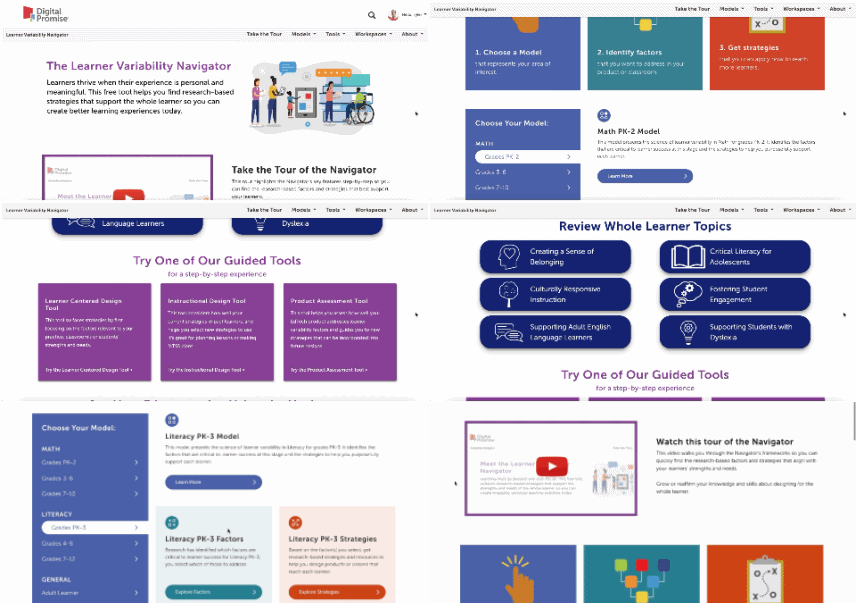
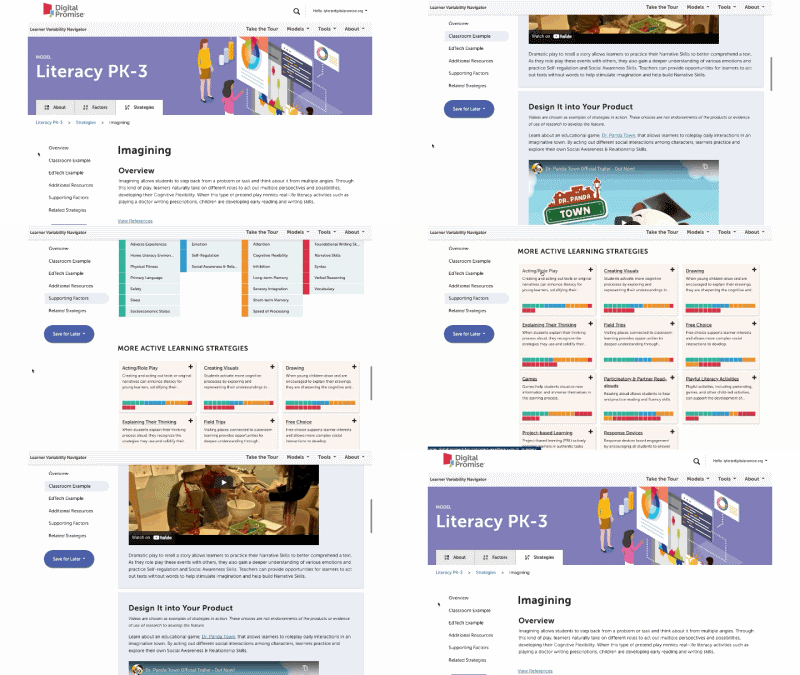
This is our homepage. You can access many of the features of the Navigator here, and learn more about how learner variability intersects with topics in education and learning. To start, select a content area – we call them Learner Models – to visit a factor map.
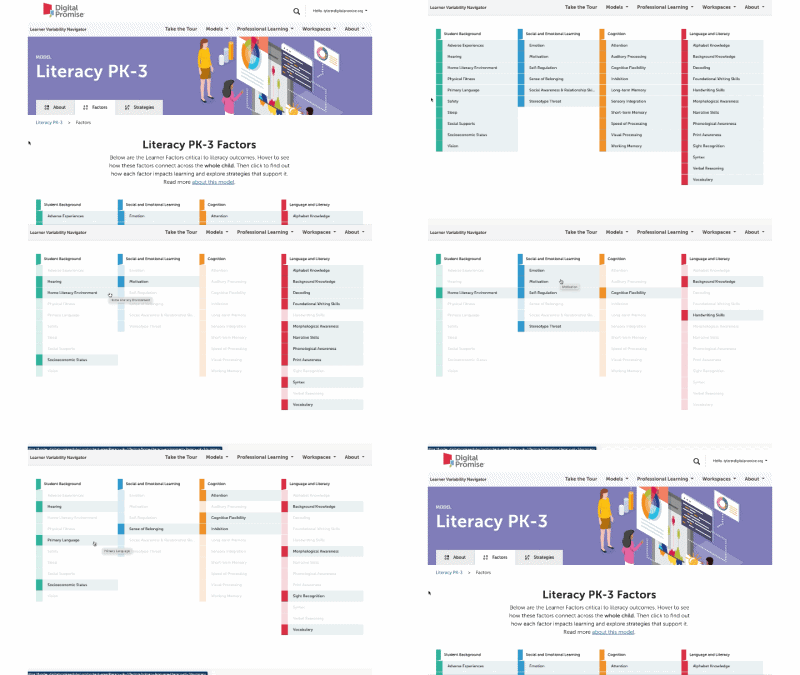
Factor maps show research-based concepts, "factors," that likely impact learning. They are organized into four categories: Learner Background, Social and Emotional Learning, Cognition, and Content Area. The map is interactive. Move your cursor over a factor to see connected factors. Select any factor to visit its summary page. We'll look at factor summary pages next.
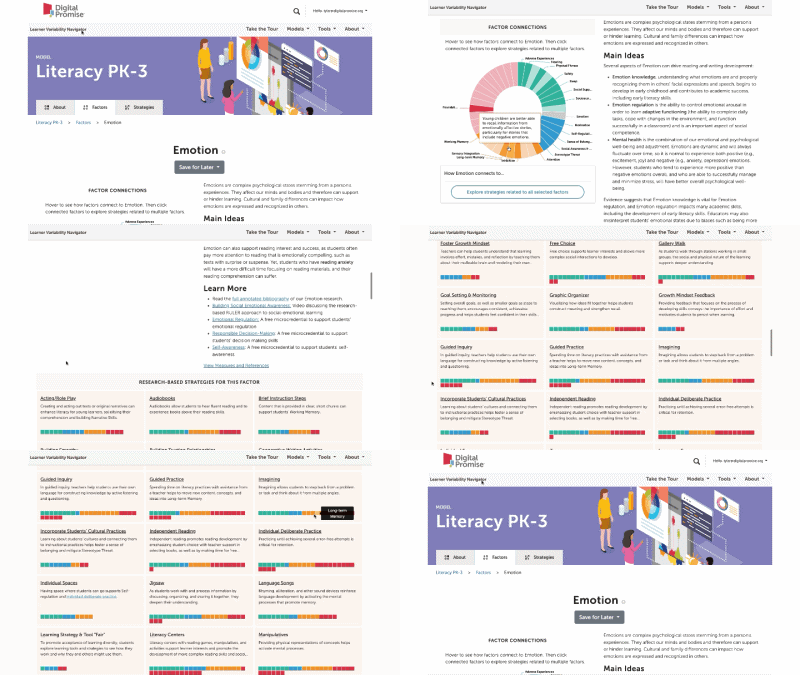
This is a factor summary page. It provides a brief definition and review of the factor, a factor connections diagram, additional resources, and strategies that support this factor. On the strategy card, the multi-colored boxes show all the factors that it supports. Select a strategy to visit its summary page.
Strategy summary pages have an overview, information about using the strategy in different learning environments, resources of interest, the factors this strategy supports, and related strategies you can explore. To view all the strategies in a content area, use the strategies tab at the top of the page. We'll look at all the Strategies for this learner model next.
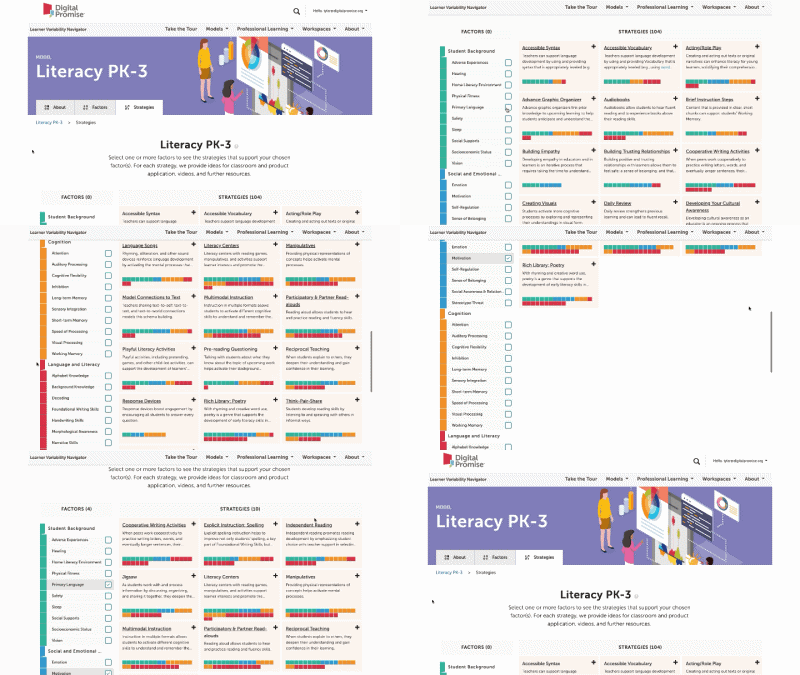
The strategy page shows ALL of the strategies for that learner model. You can select factors of interest for you or your learners, and it will narrow the strategies to only those that match all of the factors selected. This makes it easy to find key strategies to better design for learner variability. Again, select the strategy name to visit its summary page.


Already a user? LOG IN
Are you sure you want to delete this Workspace?
Enter the email address of the person you want to share with. This person will be granted access to this workspace and will be able to view and edit it.
Adjust the permissions of your Workspace.
This Workspace is .
This Workspace's Reflection Area is .
Learner variability is the recognition that each learner is a unique constellation of strengths and challenges that are interconnected across the whole child. Understanding these connections and how they vary according to context is essential for meeting the needs of each learner.
It disrupts the notion of a one-size-fits all education. Understanding learner variability helps educators embrace both students’ struggles and strengths as we connect practice to uplifting the whole learner.
Throughout the site, we talk about "factors" and "strategies." Factors are concepts research suggests have an impact on how people learn. Strategies are the approaches to teaching and learning that can be used to support people in how they learn best.
Use the Learner Centered Design Tool to build a workspace. Go to Learner Centered Design Tool.
Or, create a new blank workspace for your product or project.
Use one of the guided tools to build a workspace.
Or, create a new blank workspace for your product or project.
Make a copy of this workspace.
Redirecting soon...
Generating summary page
Loading...
On this page, using your heatmap, you will be asked to select factors to further explore, and then select new strategies you might incorporate into upcoming instruction. Once done, click “Show Summary" to view your Design Summary Report.
On this page, using your heatmap, you will be asked to select factors to further explore, and then select new strategies you might incorporate into upcoming instruction. Once done, click “Show Report” to view your Design Summary Report.
By selecting "Show Report" you will be taken to the Assessment Summary Page. Once created, you will not be able to edit your report. If you select cancel below, you can continue to edit your factor and strategy selections.
Announcement here
Item successfully added to workspace!
Issue adding item to workspace. Please refresh the page and try again.
Learner variability is the recognition that each learner is a unique constellation of strengths and challenges that are interconnected across the whole child. Understanding these connections and how they vary according to context is essential for meeting the needs of each learner. It embraces both students’ struggles and strengths. It considers the whole child.
Throughout the site, we talk about "factors" and "strategies." Factors are concepts research suggests have an impact on how people learn. Strategies are the approaches to teaching and learning that can be used to support people in how they learn best.
The Learner Variability Navigator is a free, online tool that translates the science of learner variability into factor maps and strategies that highlight connections across the whole learner. This puts the science of learning at teachers' fingertips, empowering them to understand their own practice and support each learner.